

Peptides for Sale: Research Buyer Checklist
Searching for peptides for sale is easy. Establishing that a specific lot is suitable for a defined laboratory workflow is the demanding part. A polished product page cannot tell a principal investigator whether the received vial matches its certificate of analysis, whether the analytical method is relevant, or whether receiving staff preserved a defensible chain of custody. Those answers come from documentation and repeatable checks, not marketing language.
Browse research peptides with documented specifications, then use the checklist below to evaluate the supplier, lot documentation, shipment, and internal records before material enters an experiment.
This guide is for research, laboratory, and analytical procurement only. Trusted Peptides products are not for human consumption and are not intended to diagnose, treat, cure, or prevent disease. The checklist is a practical quality-control framework, not legal advice or a substitute for your institution's procurement, environmental health and safety, or quality-assurance procedures.
Peptides for sale require more than a purity percentage
A purity figure is useful only when it can be connected to a named compound, a specific lot, a documented method, and the vial in hand. Procurement teams should therefore treat the purchase as a traceability problem. The objective is not merely to obtain a compound. It is to preserve enough evidence for another qualified researcher to understand what was ordered, received, accepted, stored, and used.
This distinction matters because a certificate can answer several different questions. Chromatographic data may estimate purity under defined conditions. Mass spectrometry can support an identity assessment. Neither result, by itself, proves that every other characteristic relevant to a protocol has been evaluated. Buyers should decide what evidence their study requires before comparing vendors.
Define acceptance criteria before opening a catalog
Write down the compound name, sequence or molecular formula where applicable, target quantity, physical form, required documentation, storage conditions, and minimum analytical evidence. Also identify who can approve a deviation. This short specification prevents the team from accepting a visually convincing certificate that does not answer the protocol's actual questions.
For a useful model of how certified materials support measurement quality, review the NIST overview of Standard Reference Materials. A commercial research peptide is not automatically a NIST reference material, but the underlying lesson is relevant: documentation, intended use, and traceability determine how confidently a material can support measurement.
Separate supplier qualification from lot acceptance
Supplier qualification asks whether a vendor can consistently provide complete records, responsive support, and appropriate research-only positioning. Lot acceptance asks whether one delivered lot meets the criteria for one intended project. A previously qualified supplier should still provide batch-specific evidence. Likewise, one acceptable lot does not eliminate the need to review future lots.
Labs building an approved-vendor list can compare this checklist with the questions in our guide to where to buy research peptides. Record the qualification decision separately from each purchase so later reviewers can distinguish vendor-level evidence from lot-level evidence.
What should a research-only supplier disclose?
A credible research supplier makes the intended-use boundary obvious throughout the buying process. Product pages, labels, invoices, and support responses should consistently frame materials for research, laboratory, or analytical purposes only. Any language that encourages personal administration, provides dosing instructions, or promises therapeutic outcomes is incompatible with a research procurement workflow.
Clear scope is only the first screen. A buyer also needs a stable business identity, a method for requesting documentation, and enough product detail to compare the listing with the purchase specification. If basic questions cannot be answered before ordering, resolving a lot discrepancy after delivery may be difficult.
Run a five-minute supplier screen
- Confirm that research-only language is clear and consistent.
- Check whether product pages identify the compound, quantity, form, and relevant specifications.
- Confirm that batch-specific COAs or lab-testing records can be requested or viewed.
- Look for a working support or contact channel and a stated fulfillment process.
- Reject vendors that make human-use, treatment, dosing, or safety-guarantee claims.
For a broader view of supplier differentiators, see our review of research peptide companies. The purpose of comparison is not to find the longest list of claims. It is to identify which supplier provides evidence aligned with your study's acceptance criteria.
Document the intended use internally
The buyer should record the project, responsible investigator, intended analytical or laboratory purpose, and any restrictions that apply. That record helps receiving and inventory teams route the material correctly. It also reduces the risk that a later user mistakes the presence of a vial in inventory for approval across unrelated studies.
Institutions may apply requirements that go beyond a vendor's policies. Consult your organization's quality, procurement, and environmental health and safety teams. For general workplace chemical communication principles, the OSHA Hazard Communication overview explains why chemical information, labels, and staff training should operate as a coordinated system.
How do you review a certificate of analysis?
A certificate of analysis, or COA, should be reviewed as a linked set of facts. Start with identity and traceability, then examine the analytical results and method context. A certificate that cannot be tied to the delivered vial should be placed on hold, even if its reported result looks strong.

Match the COA to the vial
Compare the compound name, lot or batch identifier, quantity or concentration where relevant, and test date with the label and order record. Note any mismatch before the material is released to inventory. Screenshots of a generic example COA are useful for understanding a supplier's format, but they are not evidence for an individual shipment.
Our guide to reading a peptide certificate of analysis provides a compound-specific walkthrough of the same principle. The document and the physical material must remain connected through a shared identifier.
Read HPLC results in context
High-performance liquid chromatography separates components under stated conditions and can support a purity assessment. Review the chromatogram, the reported integration, and any method details made available. Ask what the percentage represents and whether the method is appropriate for the procurement specification. A single purity number without a lot identifier or supporting trace offers little traceability.
The ICH Q2(R2) guideline on analytical procedure validation discusses characteristics such as specificity, accuracy, precision, and range. It is written for a regulated analytical context and does not certify a vendor's commercial COA. It does, however, show why the result and the suitability of the analytical procedure are separate considerations.
Understand what mass data adds
Mass spectrometry can provide evidence about molecular identity by comparing an observed signal with an expected molecular mass. It answers a different question from chromatographic purity. When both are supplied, evaluate each on its own terms rather than treating one as a substitute for the other.
For a detailed scientific discussion of peptide analytical approaches, consult this peer-reviewed review of peptide characterization and quality assessment. Use external references to inform your review framework, while basing the purchase decision on the documentation for the actual lot.
Use the COA reading guide to build your lab's review form.
Supplier evidence comparison table
The table below separates useful evidence from common warning signs. It can serve as the basis for an approved-vendor worksheet or purchase-request attachment.
| Review area | Evidence to request | Why it matters | Hold or reject signal |
|---|---|---|---|
| Intended use | Consistent research-only statements | Defines the permitted commercial scope | Human-use, dosing, or treatment claims |
| Identity | Name, sequence or formula, and relevant mass data | Supports comparison with the purchase specification | Ambiguous naming or conflicting identifiers |
| Lot traceability | Matching batch number on vial, COA, and order record | Connects analytical evidence to received material | Generic certificate or missing lot number |
| Purity evidence | Batch-specific HPLC result with supporting chromatogram | Provides analytical context for the reported percentage | Purity claim with no supporting record |
| Fulfillment | Shipment record, package condition, and discrepancy process | Supports receipt review and escalation | No channel for resolving a damaged or mismatched order |
| Internal control | Acceptance decision, storage location, and access record | Preserves chain of custody after delivery | Material released before review |
No single row proves suitability. The decision depends on the intended laboratory use and institutional policy. A disciplined buyer looks for agreement across the product listing, supplier response, COA, physical label, and receiving record.
What should happen when the shipment arrives?
Receipt inspection is where online claims meet physical evidence. Assign responsibility before delivery, so the package does not sit unexamined or move directly into general inventory. Receiving staff should document condition, match identifiers, and preserve the supplier's handling instructions while the technical reviewer completes acceptance.
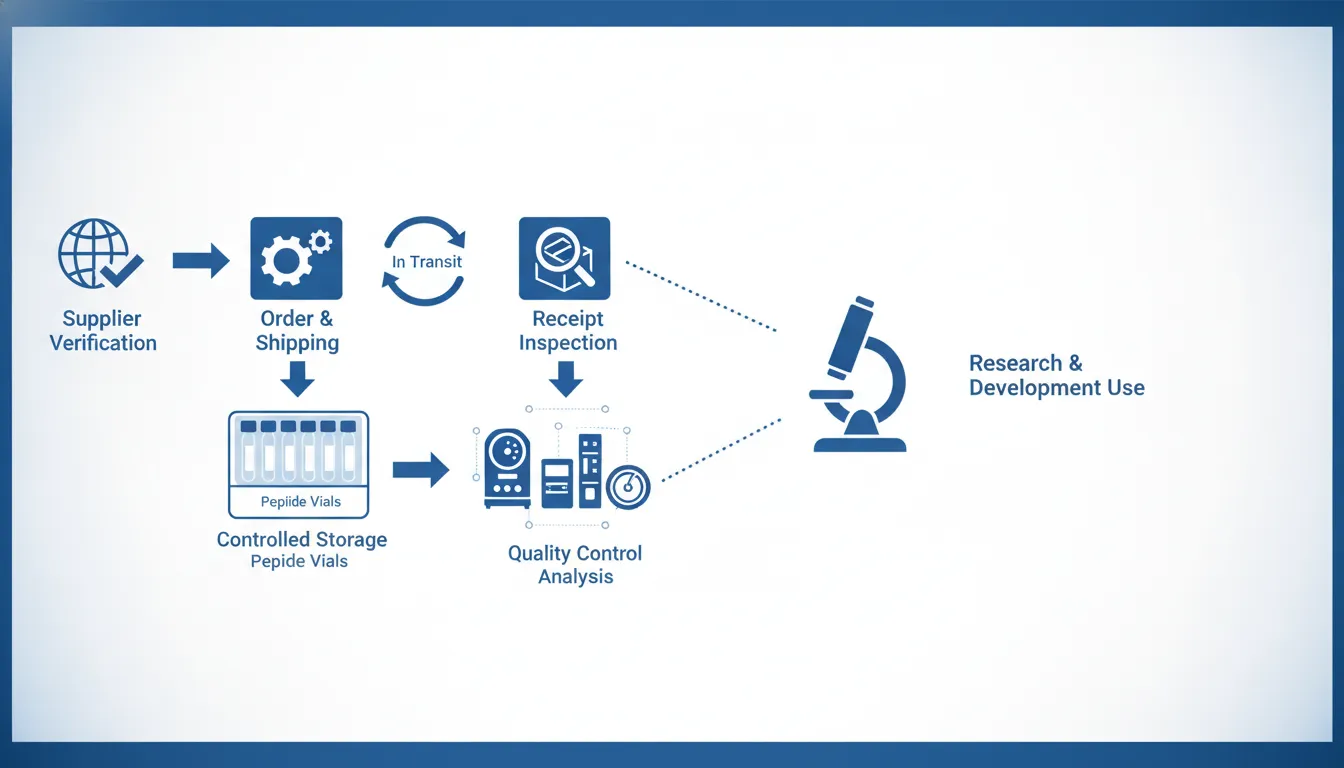
Inspect before release
- Record the arrival date, carrier condition, and package condition.
- Compare the packing record with the purchase order.
- Match the vial label and lot identifier to the batch-specific COA.
- Photograph and quarantine any damaged, leaking, warm, or mismatched item.
- Route the record to the designated technical reviewer for acceptance.
- Release the material only after the review decision is documented.
Do not improvise handling instructions based on assumptions about similar materials. Follow the supplier's documented conditions and your institution's procedures. If information is missing or inconsistent, hold the material and contact the supplier before use.
Create a discrepancy path before you need it
A useful discrepancy record states what was expected, what was observed, who was notified, and what resolution was approved. Keep the affected material segregated while the issue is evaluated. This process makes a damaged shipment or mismatched identifier a controlled event rather than an informal email thread.
Questions about an order or documentation can be directed through the Trusted Peptides contact page. Include the order and lot identifiers, but do not send confidential study data that is unnecessary to resolve the request.
Build records that support reproducible research
Procurement evidence has value after the invoice is paid. A complete file can help a team investigate an unexpected result, repeat a method with the same lot, compare performance across lots, or explain why a material was rejected. The record should be detailed enough to be useful without becoming so burdensome that staff bypass it.
Keep a minimum purchase file
- Approved purchase specification and intended research use
- Supplier qualification decision and review date
- Purchase order, invoice, and shipment record
- Product listing or specification captured at the time of purchase
- Batch-specific COA and supporting analytical records
- Receipt inspection, acceptance, quarantine, or rejection decision
- Storage location, access controls, and disposition record
The correct retention period depends on institutional policy and the nature of the work. Keep records in a controlled location with clear naming conventions. A file that exists but cannot be matched to the material or experiment does not provide practical traceability.
Use lot changes as review points
A reorder is not merely an administrative repeat. When the lot changes, compare the new documentation with the prior accepted lot and decide whether the study needs additional review. This is particularly important in longitudinal work where material consistency may affect interpretation.
Teams planning broader research programs may find the biotech peptides guide helpful for organizing product-selection questions. Keep that scientific planning separate from the formal acceptance decision for each purchased lot.
Review available research peptide blends and request the documentation your protocol requires before ordering.
A practical research peptide buying checklist
Use this checklist as a starting point, then adapt it to your quality system. A checked box should point to evidence, not simply confirm that someone viewed a page.
Before purchase
- Define the intended research use and acceptance criteria.
- Confirm the supplier uses consistent research-only positioning.
- Review product identity, quantity, form, and available specifications.
- Request a representative COA format and confirm batch-specific records are available.
- Identify the internal approver and discrepancy path.
At receipt
- Document package condition and arrival details.
- Match the order, vial label, lot number, and COA.
- Review the analytical evidence against the purchase specification.
- Quarantine any damaged, mismatched, or insufficiently documented material.
- Record acceptance before release to the project.
During the project
- Preserve the connection between the lot and experimental records.
- Follow documented storage and access procedures.
- Record deviations, discrepancies, and disposition.
- Repeat the lot review when a new shipment arrives.
For teams reviewing multiple buying options, our research peptide vendor vetting guide adds practical comparison questions. Avoid choosing on price or purity percentage alone. The most useful supplier is the one whose evidence fits your defined workflow and can be reviewed lot by lot.
Frequently asked questions
What documentation should accompany research peptides?
At minimum, a buyer should seek product identity information, a matching batch or lot identifier, a batch-specific certificate of analysis, relevant analytical results, and documented handling or storage conditions. The exact requirements depend on the intended laboratory use and institutional policy. Materials should remain on hold when critical identifiers or records do not match.
Does an HPLC purity result confirm peptide identity?
No. HPLC data and identity evidence answer different analytical questions. Chromatography can support a purity assessment under stated conditions, while techniques such as mass spectrometry can support identity assessment. Buyers should review the available evidence against their predefined acceptance criteria rather than relying on one percentage.
Can research-only peptides be used in people?
No. Products described here are for research, laboratory, or analytical purposes only and are not for human consumption. They are not intended to diagnose, treat, cure, or prevent disease. A vendor that promotes personal administration, dosage, or therapeutic outcomes should not pass a research-supplier screen.
What should a lab do when a COA does not match the vial?
Place the material on hold, preserve the package and records, document the mismatch, and contact the supplier. Do not release it to a project until the discrepancy is resolved and the decision is recorded by the appropriate reviewer.
How often should a supplier be requalified?
The schedule should follow the lab's quality system and risk assessment. In addition to periodic review, reassess after material discrepancies, unexplained documentation changes, repeated fulfillment problems, or major changes in the supplier's business or testing practices.
Choose evidence before claims
A dependable procurement decision begins before checkout and continues after delivery. Define what your study requires, verify research-only positioning, match the COA to the lot, review analytical evidence in context, and preserve the acceptance record. This approach turns an online purchase into a controlled laboratory input.
Trusted Peptides supplies lab-grade research peptides with third-party HPLC testing, transparent purity documentation, batch consistency, and custom formulation capabilities. All products are for research, laboratory, or analytical purposes only and are not for human consumption.
Browse lab-verified research peptides and review your options.
