

Intranasal Peptide Administration: Mechanisms and Laboratory Research Applications
Laboratory studies require precise methods for delivering peptides to the central nervous system without invasive surgery. Intranasal transport offers a unique pathway that moves compounds directly to the brain. This approach improves bioavailability by avoiding metabolic breakdown in the liver.
Browse our collection of research-grade intranasal peptide compounds designed for preclinical central nervous system studies.
Intranasal peptide administration provides a direct and non-invasive delivery route for research compounds targeting the central nervous system in laboratory settings. This method uses the nasal cavity to bypass the blood-brain barrier, which typically impedes large molecules from reaching the brain in study models. Research documented in the National Institutes of Health database confirms that the nasal mucosa offers a large absorptive surface area with high vascular perfusion, enabling rapid systemic uptake of research peptides. By circumventing gastrointestinal degradation and hepatic first-pass metabolism, this pathway achieves superior bioavailability and faster pharmacokinetic profiles in preclinical investigations. The technique is essential for evaluating novel peptide therapeutics in neurological research models and provides a reliable alternative to parenteral administration for laboratory studies.
How Does the Nasal Cavity Absorb Peptides in Research Settings?
The nasal cavity serves as a unique entry point for macromolecules in study models. Its large surface area and extensive vascular network facilitate rapid compound uptake. This anatomical structure enables research compounds to reach systemic circulation or brain tissue efficiently. In comparative studies, this route demonstrates a significantly faster onset of action than oral or transdermal administration. Investigators routinely measure these pharmacokinetic parameters to evaluate different delivery methodologies.
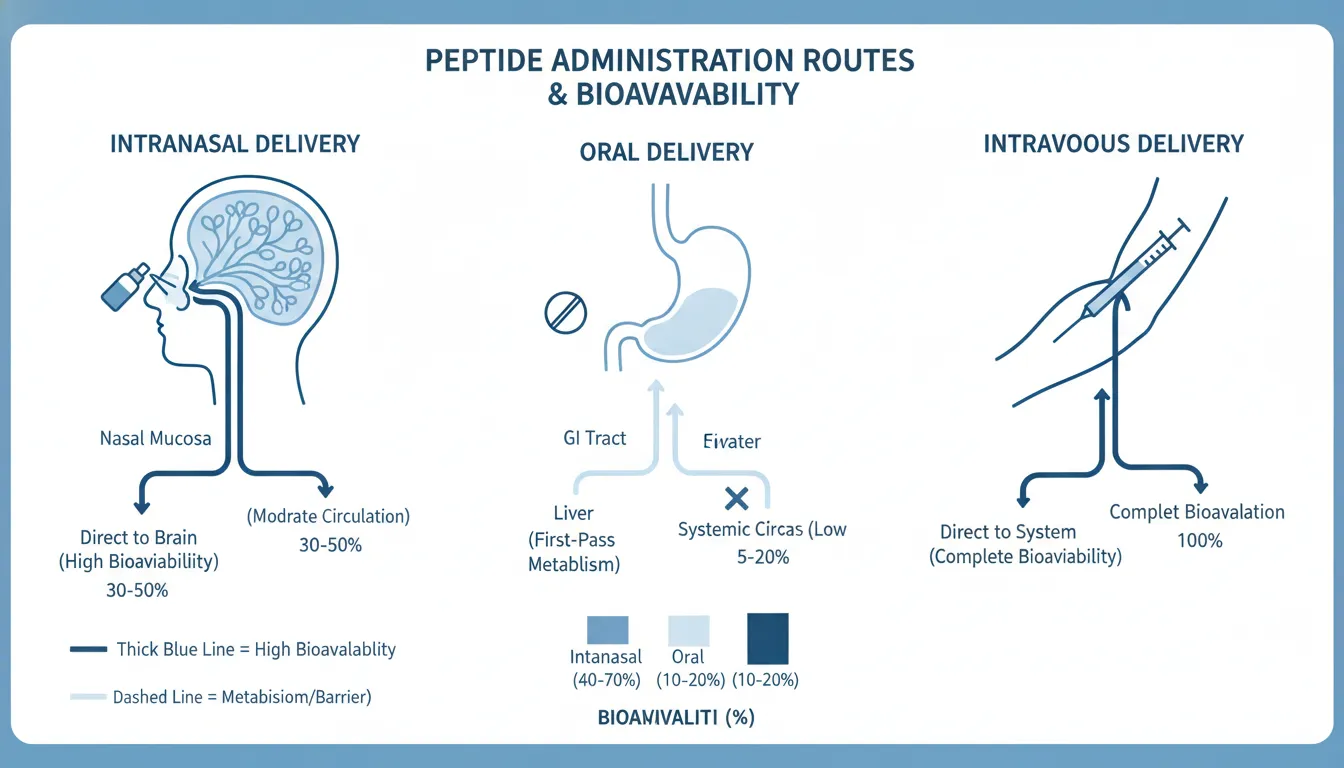
The respiratory epithelium in the nasal passages acts as a permeable interface for complex molecules. This membrane is substantially more porous than dermal or gastrointestinal epithelia. Sustained blood flow in this region maintains a favorable concentration gradient, driving passive diffusion of research peptides during intranasal peptide administration. This intrinsic permeability permits the passage of compounds with molecular weights up to approximately 1,000 Da under optimal conditions.
How the nasal mucosa works
The nasal mucosa represents the primary absorption site in intranasal research applications. It comprises a thin epithelial layer overlying a dense capillary network. This architecture allows small to medium peptides to translocate directly into systemic circulation. Researchers frequently select this route to study labile compounds that would otherwise undergo degradation in the gastrointestinal tract. It provides a reproducible platform for evaluating novel research compounds.
By utilizing the nasal route, investigators circumvent the acidic environment of the stomach. This pathway also avoids hepatic first-pass metabolism, thereby improving the fraction of administered compound available for systemic distribution in animal models. These characteristics make intranasal delivery a preferred method for testing protease-sensitive research peptides. A greater proportion of the administered dose reaches its intended target in the study model compared to enteral routes.
Direct nose to brain pathways
A principal advantage of this route is the capacity to circumvent the blood-brain barrier. Using intranasal peptide administration in research permits direct targeting of brain tissues. This bypass occurs through the olfactory and trigeminal nerve pathways, which project from the nasal cavity directly into central nervous system structures.
A landmark study by Born et al. in 2002 demonstrated the rapidity of this transport mechanism. The researchers found that peptides including insulin reached the cerebrospinal fluid within 10 minutes of nasal administration. This rapid translocation is critical for studies investigating central nervous system function. It confirms that the nasal cavity serves as a direct anatomical conduit to the brain in research settings. Investigators leverage this pathway to study neuroactive compounds without recourse to invasive stereotaxic procedures.
Improving peptide stability
Peptide stability represents a significant challenge in nasal delivery research. Metabolic enzymes within the nasal cavity can degrade labile compounds before they reach their intended target. To address this, researchers employ absorption enhancers that preserve peptide integrity. These tools are a standard component of advanced research-grade formulations.
Cyclodextrins are one class of excipient used to enhance nasal absorption. These cyclic oligosaccharides form inclusion complexes with peptide molecules, shielding them from enzymatic degradation. This protection yields more consistent pharmacokinetic data in preclinical studies. Using these enhancers enables researchers to maximize compound delivery in their experimental models. They function by modifying the physicochemical properties of the peptide within the formulation vehicle.
What Are the Olfactory and Trigeminal Pathways for Nose-to-Brain Delivery?
Research demonstrates that nasal delivery mechanisms allow compounds to reach brain tissue while circumventing the blood-brain barrier. This bypass is fundamental to intranasal peptide administration in laboratory investigations. By engaging specific neural pathways, laboratories can deliver peptides directly to brain parenchyma. This method circumvents systemic degradation and enhances the fraction of compound reaching central targets. Scientists employ these routes to evaluate peptide effects on neurological function without the limitations imposed by other delivery modalities. Intranasal administration offers a practical approach for targeted brain region delivery in experimental models.
The Olfactory Nerve Pathway
The olfactory epithelium pathway represents the primary route for direct nose-to-brain transport. In this mechanism, peptides undergo transport along olfactory sensory neurons. These neurons project from the nasal epithelium through the cribriform plate to the olfactory bulb. This connection enables rapid entry into the forebrain. In studies of exendin-4, investigators observed preferential accumulation via this pathway. The peptide demonstrated elevated concentrations in the hippocampus in these experimental models. This route is a primary focus for investigations into cognitive function and neuroprotection.
Peptides may traverse the paracellular spaces surrounding these neurons to reach the cerebrospinal fluid. This transport occurs rapidly and bypasses systemic circulation entirely. It enables higher brain concentrations than those achieved by oral or parenteral administration. Laboratory research leverages this route to evaluate peptide activity in neural tissue. It provides a methodology for studying brain targets without invasive surgical techniques. Studies confirm that the nasal cavity maintains direct anatomical connectivity to the brain through these neural pathways.
The Trigeminal Nerve Pathway
The trigeminal nerve pathway constitutes the second major route for central nervous system delivery. These nerve fibers innervate the nasal cavity and project to the brainstem and spinal cord. Peptides travel along these neural processes to reach posterior brain regions. This route facilitates targeting of the pons, medulla oblongata, and upper spinal cord in laboratory investigations. It complements the olfactory pathway by providing access to additional brain structures. Laboratories use this route to study peptide effects on autonomic function, arousal, and pain processing.
Rapid transport has been documented via trigeminal pathways in experimental models. One investigation detected a GLP-2 analog in the brainstem within three minutes of nasal instillation. This rapid time course demonstrates the efficiency of this route for research applications. It enables rapid pharmacokinetic assessment in early-phase studies. This pathway is valuable for studying peptides that require rapid access to brainstem targets. Investigators can track these transport kinetics to evaluate the performance of nasal spray formulations in the laboratory.
Improving Delivery with Research Enhancers
Contemporary research investigates strategies to enhance the efficiency of these neural pathways. One approach employs cell-penetrating peptides (CPPs), such as L-penetratin. A 2021 study in MDPI Pharmaceutics demonstrated that CPPs significantly increase brain peptide delivery following nasal administration. These carrier molecules facilitate transmembrane transport of the conjugated peptide. This process elevates the fraction of compound reaching central targets. It represents a significant tool for intranasal peptide administration in the research laboratory.
Additional work published in Frontiers in Pharmacology (2022) investigated CPP conjugation with antidiabetic peptides. These studies confirmed that CPPs enhance peptide stability and accelerate brain uptake. This finding is relevant for research on metabolic signaling and neurodegeneration. By employing CPPs, laboratories achieve improved experimental outcomes with reduced compound requirements. This approach enables more cost-effective and precise research studies. These tools are increasingly important for advanced peptide research in laboratory settings.
What Factors Affect Bioavailability in Intranasal Peptide Administration?
The success of intranasal peptide administration in research depends on both biological and physicochemical variables. While this route circumvents the blood-brain barrier, investigators must account for enzymatic activity within the nasal cavity. Studies indicate that the nasal epithelium expresses multiple enzyme systems, including cytochrome P450 isoforms and peptidases, that can metabolize peptide substrates. These enzymes constitute a metabolic barrier that can result in enzymatic degradation of experimental compounds. This process frequently reduces the quantity of intact peptide reaching its target in study models.
Enzymatic barriers and degradation
Nasal enzymes present a substantial obstacle to peptide stability in research settings. Beyond cytochrome P450, peptidases including aminopeptidases and endopeptidases can rapidly hydrolyze peptide bonds. In experimental models, these enzymes serve a protective function against environmental toxins, but they simultaneously reduce the efficacy of research-grade nasal spray compounds. Research demonstrates that the rate of peptide degradation depends on amino acid sequence and tertiary structure. Certain peptides exhibit significantly greater susceptibility to proteolytic cleavage by local enzymes than others.
To mitigate this, investigators employ enzyme inhibitors or structural modifications to enhance peptide stability. In laboratory studies, co-administration of protease inhibitors such as bacitracin has preserved peptide integrity within the nasal mucosa. An alternative approach involves cyclodextrins. These cyclic sugar molecules encapsulate peptide cargo, providing steric protection from enzymatic attack. They also improve peptide solubility in aqueous research vehicles.
Formulation strategies for better absorption
Achieving reproducible results in the laboratory requires addressing the challenge of mucosal peptide transport. Mucoadhesive polymers are commonly employed to prolong nasal residence time. By incorporating polymers such as chitosan, researchers can delay mucociliary clearance of the administered formulation. This extended contact time enhances absorptive uptake. This consideration is important because dose volume limitations represent a significant drug development constraint for intranasal peptide products.
Absorption enhancers are also standard components of these research formulations. These agents, including bile salts and fatty acids, transiently increase paracellular permeability to facilitate peptide transport. However, investigators must monitor for potential mucosal irritation. In laboratory work, the selection of absorption enhancer depends on peptide molecular weight, charge, and lipophilicity. The objective is to maximize the bioavailable fraction of the administered dose without compromising nasal epithelial integrity.
Species differences in nasal metabolism
When translating findings from rodent models to human applications, scientists must account for interspecies anatomical and physiological differences. Rats are obligate nasal breathers and possess a substantially larger olfactory epithelial surface area relative to humans. Additionally, the expression profiles and catalytic activities of enzymes such as cytochrome P450 vary considerably between species. These differences can produce divergent pharmacokinetic outcomes even when employing identical research-grade nasal spray compounds in both model systems.
Understanding these species-specific factors is critical for interpreting data from preclinical models. For example, a peptide that remains stable in the rat nasal cavity may undergo rapid degradation in human tissue due to differing enzyme activities. By accounting for these variables, researchers can design more informative studies that generate translatable results. Contemporary methodologies now employ human nasal epithelial cell cultures to better predict cross-species compound behavior.
Preclinical Research Models for Intranasal Peptide Studies
Laboratory research models are essential for characterizing peptide transport from the nasal cavity to the brain. These studies enable investigators to identify strategies for circumventing the blood-brain barrier. Combining animal and human models reveals how intranasal peptide administration functions in experimental settings. Researchers employ non-invasive administration routes to track compound distribution through neural pathways. They also assess behavioral and biochemical endpoints in test subjects during these laboratory investigations.
| Study Model | Peptide(s) Used | Key Finding | Species |
|---|---|---|---|
| Born et al. (2002) Nature Neuroscience | Melanocortin, Vasopressin, Insulin | CSF detection within 10 min; peak 30-80 min | Human |
| NAP neuroprotection study | NAP peptide | Decreased anxiety-like behavior in aging models | Mouse |
| Kamei et al. (2021) Pharmaceutics | Exendin-4, Insulin + L-penetratin | Enhanced direct nose-to-brain via olfactory pathway | Rat |
| Frontiers in Pharmacology (2022) | Antidiabetic peptides + CPPs | Systemic and brain delivery via trigeminal route | Rat |
Human Subjects and CSF Research Models
A landmark investigation employed human subjects to characterize peptide entry into the central nervous system. This work, published in Nature Neuroscience, remains a foundational reference for intranasal delivery researchers. The study examined three distinct compounds: melanocortin, vasopressin, and insulin. These peptides were selected for their diverse central nervous system activities. Investigators sampled cerebrospinal fluid at predetermined intervals following intranasal spray administration. This protocol enabled temporal tracking of peptide appearance in the CSF compartment.
The results demonstrated that all three peptides appeared in the CSF within ten minutes of administration. Peak concentrations occurred between 30 and 80 minutes post-dose. This investigation confirmed that intranasal delivery can transport macromolecules to the brain with remarkable speed. The route circumvents the blood-brain barrier, which would otherwise restrict CNS entry of these polar compounds. By bypassing this barrier, the peptides reached their central targets without undergoing systemic dilution. This study remains a cornerstone for how laboratories evaluate nose-to-brain delivery in human translational research. For additional information on related research protocols, explore our peptide selection guide for laboratory investigations.
Rodent Models for Brain Research
Rodent models represent the most widely used experimental system in intranasal peptide research. Mice and rats enable investigators to evaluate peptide effects on brain function at cellular and behavioral levels. For example, studies in aged mouse models frequently employ the neuroprotective peptide NAP. Researchers utilize these models to examine potential protective effects on neural tissue in controlled laboratory conditions. These animal systems are valuable for longitudinal study designs. They permit histological and molecular analysis of brain tissue after experimental completion.
Scientists also employ rodents to evaluate nasal enzymatic peptide degradation. The nasal mucosa contains multiple metabolizing enzymes capable of compound modification. These enzymes can reduce the quantity of intact peptide reaching central targets. By employing rodent models, laboratories can test novel formulations incorporating enzyme inhibitors. They can also evaluate mucoadhesive vehicles that prolong nasal retention. This research helps laboratories ensure peptide stability throughout the experimental window. Review our third-party COA documentation for quality-verified research compounds suitable for these study designs.
Olfactory Pathway and Insulin Studies
Insulin serves as a prototypical model peptide for studying brain-targeted intranasal delivery. In laboratory research, insulin reaches the hippocampus via olfactory pathway transport. The hippocampus is a brain region central to memory and spatial navigation. By engaging the nose-to-brain route, insulin can access this target without altering systemic glucose homeostasis. Preclinical models confirm that this pathway enables anatomically precise delivery to discrete brain regions.
Researchers can utilize our catalog of research peptides to obtain high-purity compounds for these investigations. Compound purity is essential for generating reproducible laboratory data. Many laboratories source research-grade nasal spray formulations to test these neural pathways in their own experimental systems. Using verified, high-purity compounds ensures that experimental findings are attributable to the peptide under investigation. These models continue to advance the understanding of how intranasal administration can target specific brain functions in animal research.
Laboratory Applications of Intranasal Peptide Delivery
Laboratory research employs peptides to bridge the gap between small-molecule drugs and large biologic therapeutics. Investigators currently study over 40 approved peptide drugs spanning this molecular continuum. In numerous laboratories, intranasal peptide administration has emerged as a critical experimental tool. It enables researchers to evaluate peptide activity without enteral or parenteral administration. This method is applicable across diverse investigation areas, from metabolic signaling to neurological function.
Peptide Research and Metabolic Studies
Investigations of metabolic function often focus on optimizing compound delivery to systemic circulation. In laboratory research, nasal administration avoids the acidic environment of the gastrointestinal tract. It also circumvents hepatic first-pass metabolism. This improves the fraction of bioactive peptide available in the study model. Research on incretin analogs such as exendin-4 and insulin demonstrates the effectiveness of this route in experimental settings. Bypassing digestive and hepatic barriers preserves peptide structural integrity (PMC10818989).
Research teams employ these methods to study glucose regulation and energy homeostasis. By using intranasal administration, they can monitor the pharmacokinetic profile of peptide entry into systemic circulation. This helps identify optimal formulation parameters for new experimental designs. It also reduces handling stress on animal models. Lower stress levels contribute to more reliable data in early-phase investigations.
Brain Study Models
One of the principal obstacles in neuroscience research is the blood-brain barrier. This endothelial barrier restricts the CNS entry of most systemically administered compounds. However, intranasal peptide administration circumvents this barrier. It exploits neural pathways to deliver compounds directly to brain tissue (PMC10818989). This makes it a preferred method for studies of memory, neurodegeneration, and neuroprotection.
Researchers employ this route to investigate neuropeptides in aging animal models. For example, the peptide NAP has been used in studies examining hippocampal protection. These experiments contribute to understanding how peptides might support neural health in aging. Research teams can use intranasal research methods to evaluate how these compounds function in living models. This approach continues to generate insights into maintaining neural tissue function across the lifespan. For additional context on mitochondrial research applications, see our analysis of SS-31 in mitochondrial bioenergetics research.
Advanced Research Methods
Contemporary laboratory work also focuses on optimizing peptide delivery efficiency. Some investigations employ cell-penetrating peptides to facilitate intracellular compound transport. These molecules function as molecular shuttles, enabling membrane translocation. This allows researchers to access intracellular compartments that are otherwise difficult to target. It also enables the use of lower compound doses while maintaining measurable experimental effects.
Modern laboratory methods additionally focus on preventing peptide degradation during experimental procedures. Research teams employ multiple strategies to enhance study outcomes:
- Modified peptide backbones incorporating D-amino acids to resist enzymatic cleavage.
- Enzyme inhibitors that reduce metabolic activity in the nasal mucosa.
- Permeation enhancers that facilitate compound transport across epithelial barriers.
These approaches ensure that the compound remains bioactive for the duration of the measurement window. They are essential for generating high-quality data in contemporary peptide research. Browse our peptide blend collection for pre-formulated combinations designed for specialized research applications.
Formulation Considerations for Research-Grade Nasal Preparations
Creating effective peptide formulations for laboratory use requires comprehensive understanding of the nasal microenvironment. In preclinical investigations, researchers must address multiple barriers to ensure compound delivery to the intended target. The general process for developing an intranasal peptide formulation for laboratory research follows a systematic sequence of optimization steps:
- Peptide solubility assessment. Evaluate the compound solubility at the desired concentration in an aqueous vehicle. Consider the pH range compatible with nasal tolerability (pH 4.5-6.5).
- Stability screening. Incubate the peptide in nasal mucosal homogenates or simulated nasal fluid. Measure the degradation half-life and identify vulnerable peptide bonds.
- Enzyme inhibitor selection. If degradation exceeds acceptable limits, test protease inhibitors or structural modifications such as cyclization or D-amino acid substitution.
- Absorption enhancer optimization. Screen permeation enhancers including bile salts, fatty acids, and chitosan derivatives. Evaluate both transport enhancement and potential tissue toxicity using in vitro epithelial models.
- Mucoadhesive polymer incorporation. Add rheology-modifying agents such as Carbopol or hydroxypropyl methylcellulose to increase nasal residence time and resist mucociliary clearance.
- Preservative and antioxidant addition. Include excipients to maintain chemical stability during storage, particularly for multi-dose formulations.
- In vivo pharmacokinetic validation. Administer the final formulation to an appropriate rodent model. Measure plasma and tissue concentrations to confirm bioavailability targets.
pH and formulation tonicity
The pH value of intranasal preparations significantly influences both peptide stability and mucosal tolerability. The optimal pH range for nasal formulations is between 4.5 and 6.5, aligning with the physiological pH of the nasal mucosa. Formulations outside this range may cause epithelial irritation or ciliotoxicity, compromising barrier function and confound experimental results. Additionally, pH affects peptide ionization state and solubility.
Tonicity is an equally important consideration. Hypotonic formulations can cause epithelial swelling, while hypertonic solutions may induce cellular dehydration and discomfort in animal models. Isotonic preparations matched to approximately 290 mOsm/kg are preferred for reproducible research outcomes. Buffering agents such as phosphate or citrate buffers are commonly incorporated to maintain pH stability throughout the experimental window.
Preservative selection and multi-dose stability
Research formulations intended for repeated administration require antimicrobial preservation. Benzalkonium chloride at 0.01% w/v is a commonly used preservative in intranasal research preparations. However, investigators must verify that the selected preservative does not interfere with peptide stability or biological activity. Compatibility testing is therefore an essential step in formulation development.
For multi-dose studies, the formulation must also demonstrate chemical stability throughout the intended storage period. Lyophilized peptide stored separately from the vehicle and reconstituted immediately before use is a common strategy to extend formulation shelf life. This approach maintains peptide integrity while enabling convenient laboratory use. The option for custom formulation is one of the advantages of sourcing through specialized research nasal spray suppliers that understand laboratory requirements.
Frequently Asked Questions About Intranasal Peptide Administration
How does intranasal peptide administration differ from oral peptide delivery in research?
Intranasal administration bypasses gastrointestinal degradation and hepatic first-pass metabolism, resulting in significantly higher systemic bioavailability compared to oral delivery. While oral peptides face enzymatic breakdown in the stomach and intestines, intranasal delivery takes advantage of the nasal mucosa's permeability and vascularity to achieve rapid systemic absorption. Additionally, intranasal administration enables direct nose-to-brain transport, which is not achievable with oral routes.
What is the typical bioavailability range for intranasal peptide administration in preclinical studies?
Bioavailability for intranasal peptide administration varies widely depending on peptide molecular weight, formulation characteristics, and species. In general, small peptides (under 1,000 Da) may achieve 10-50% systemic bioavailability in rodent models, while larger peptides typically show lower values. The addition of absorption enhancers and mucoadhesive polymers can significantly improve these figures. Direct nose-to-brain transport typically delivers 0.1-1% of the administered dose to brain tissue.
Can large peptides be delivered effectively via the intranasal route?
Peptide molecular weight is a critical determinant of nasal absorption. Compounds under 1,000 Da generally cross the nasal epithelium efficiently. Peptides between 1,000 and 5,000 Da demonstrate variable absorption depending on formulation. Above 5,000 Da, absorption becomes limited without the use of permeation enhancers or cell-penetrating peptides. However, with appropriate formulation strategies, peptides up to approximately 10,000 Da can achieve measurable systemic and central nervous system delivery in research models.
What enzymes in the nasal cavity degrade peptides during administration?
The nasal mucosa expresses multiple enzyme systems capable of peptide metabolism, including cytochrome P450 isoforms (particularly CYP1A1, CYP2A6, and CYP2B1), aminopeptidases, endopeptidases, carboxypeptidases, and esterases. The activity and expression profile of these enzymes varies by species, which is a key consideration when translating rodent findings to human models. The use of enzyme inhibitors or structural peptide modifications can mitigate enzymatic degradation in research formulations.
Which preclinical animal model best represents human intranasal peptide absorption?
No single animal model perfectly replicates human nasal anatomy and physiology. Rodents have a proportionally larger olfactory epithelium and are obligate nasal breathers, which can overestimate nose-to-brain transport. Rabbits and non-human primates offer closer anatomical similarity to humans. Sheep have also been used for intranasal absorption studies due to their accessible nasal cavity. Most researchers employ a combination of rodent models for mechanistic studies and larger species or human nasal epithelial cell cultures for translational validation.
Ready to Advance Your Intranasal Peptide Research?
Trusted Peptides provides research-grade nasal spray formulations and individual peptide compounds with rigorous third-party HPLC purity testing and complete COA documentation. Our catalog includes custom formulation capabilities for laboratories requiring specialized intranasal peptide preparations for preclinical investigations.
Browse our nasal spray collection to explore available research compounds, or contact our team for assistance with custom formulation requirements for your next intranasal peptide administration study.
