

CJC 1295 DAC vs No DAC: Comparing Synthetic GHRH Analogs in Research
A single molecular modification determines whether CJC-1295 remains active for thirty minutes or over one week. This structural difference separates the Drug Affinity Complex (DAC) variant from the standard peptide sequence. Laboratory outcomes depend on which pharmacokinetic profile a researcher selects for their study design.
Browse the peptide catalog: For research-grade CJC-1295 with and without DAC, explore the full selection of synthetic GHRH analogs at Trusted Peptides.
The cjc 1295 dac vs no dac difference centers on a Drug Affinity Complex that binds circulating albumin, extending half-life to 6-8 days versus 30-60 minutes without it. Researchers choose based on whether steady hormone elevation or natural pulsatile release suits their protocol.
Understanding the molecular science behind these variants helps researchers predict receptor interactions, design appropriate dosing schedules, and interpret study outcomes. This analysis examines the chemical structure differences, pharmacokinetic profiles, and research applications that distinguish these two GHRH analogs.
CJC-1295 Research Formulation: For experimental protocols comparing growth hormone secretagogue activity, Trusted Peptides offers optimized CJC-1295 No DAC / Ipamorelin blend containing 2 mg Mod GRF 1-29 and 6 mg Ipamorelin. This blend provides a pulsatile research standard. Standalone CJC-1295 with DAC is also available for sustained-elevation studies.
What Is CJC 1295 DAC vs No DAC and How Does the Drug Affinity Complex Work?
CJC-1295 is a synthetic 29-amino-acid GHRH analog for laboratory investigation of growth hormone secretion pathways. The DAC modification binds circulating albumin, extending the peptide's active window from minutes to several days in research models.
CJC-1295 is a synthetic analog of growth hormone-releasing hormone (GHRH). In laboratory experiments, researchers use it to investigate how secretagogues stimulate pituitary somatotroph cells. This peptide derives from the first 29 amino acids of the native GHRH sequence, with modifications that improve stability compared to the endogenous hormone. The research peptide catalog offers both variants for controlled study models.
Chemical Structure and Sequence
The molecular formula of CJC-1295 with DAC is C152H252N44O42, with a molecular weight of 3367.95 g/mol. It functions as a 29-amino-acid peptide that mimics GHRH signaling at the pituitary receptor. Through GHRH receptor binding, the compound initiates growth hormone synthesis and release in experimental models. Research focuses on how structural modifications protect the peptide from enzymatic degradation, enabling longer observation windows in preclinical investigations.
Native GHRH exhibits a very short half-life in laboratory settings, limiting its utility in extended research models. Specific amino acid substitutions protect the synthetic analog from dipeptidyl peptidase-4 (DPP-4) cleavage. Scientists use these stabilized analogs to study the IGF-1 cascade and growth-regulatory pathways. Data from third-party HPLC testing and COAs enables researchers to verify compound purity before initiating new study protocols.
The Drug Affinity Complex Modification
The defining structural feature of DAC-conjugated CJC-1295 is the Drug Affinity Complex, a molecular moiety that enables covalent binding to serum albumin. Albumin functions as a long-circulating carrier protein in mammalian research models. When CJC-1295 with DAC binds to albumin, the peptide is protected from rapid renal clearance and enzymatic degradation. This binding mechanism represents a significant area of inquiry in peptide pharmacokinetic research.
Studies indexed on PubMed demonstrate that the DAC modification extends functional half-life from approximately 30 minutes to 6-8 days in animal models. Without DAC, the compound undergoes rapid clearance, giving researchers a tool for studying pulsatile GH signaling. Many investigators select the CJC-1295/Ipamorelin research blend when their protocol requires short-acting analogs without the DAC modification.
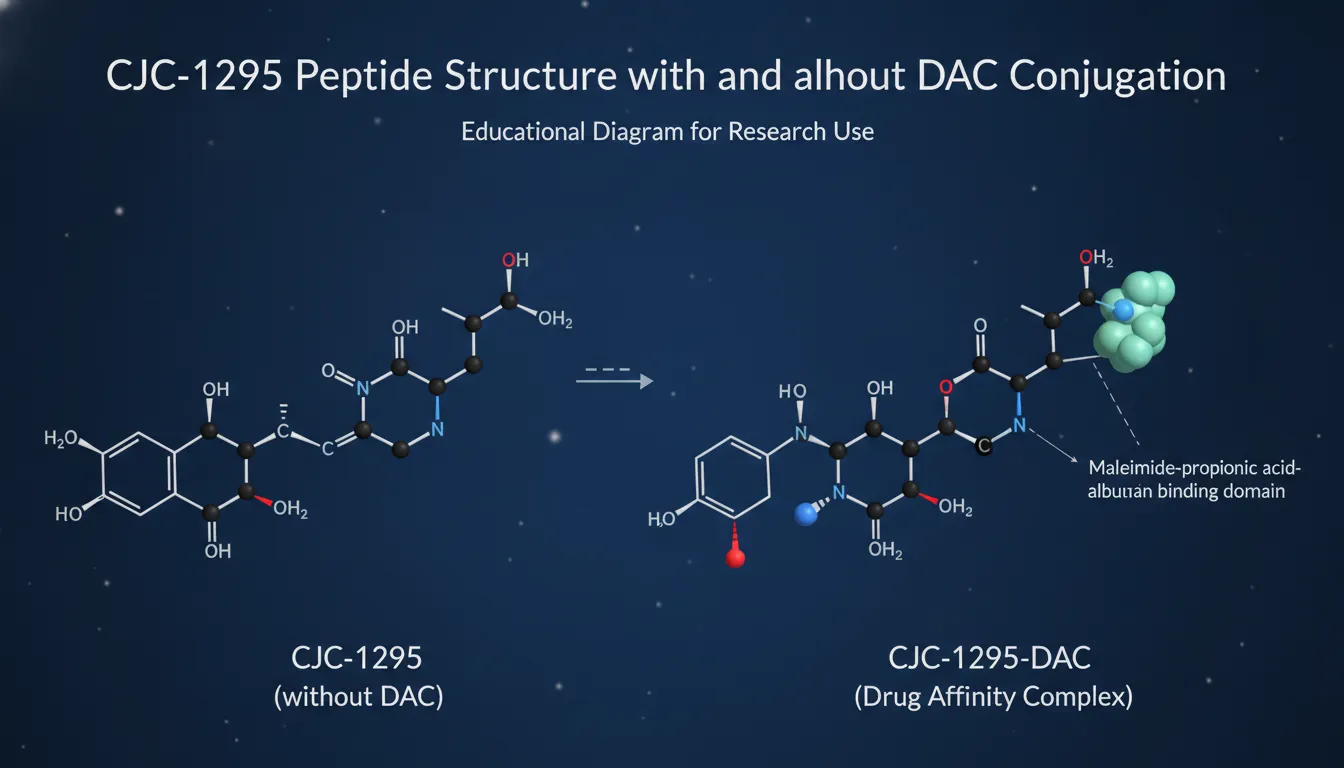
CJC-1295 without DAC vs with DAC: Structural Comparison
Peptides lacking the DAC moiety are frequently designated Mod GRF 1-29. These compounds share the identical core amino acid sequence as the DAC variant but lack the albumin-binding conjugation. This single difference fundamentally alters their pharmacokinetic behavior in laboratory studies. Mod GRF 1-29 produces brief, transient spikes in growth hormone levels that resemble endogenous pulsatile release. In contrast, the DAC-conjugated variant sustains elevated GH secretion over extended periods.
CJC-1295 With DAC vs Without DAC: A Pharmacokinetic Comparison
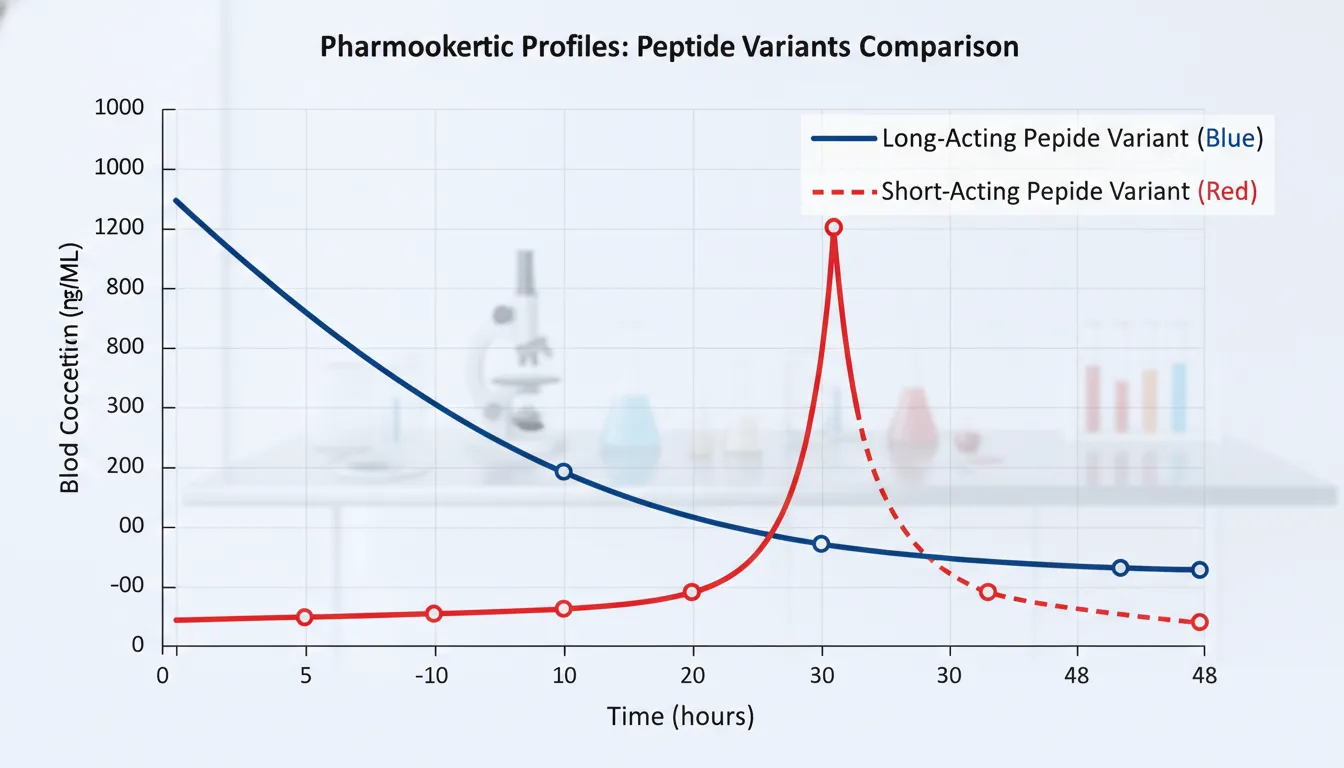
The primary pharmacokinetic distinction is half-life: CJC-1295 with DAC remains active for 6-8 days via albumin binding, while the non-DAC variant clears within 30-60 minutes. This divergence drives differences in GH release pattern, dosing frequency, and suitability for distinct research objectives.
The central division in CJC-1295 research originates from duration of action. When evaluating cjc 1295 dac vs no dac, the DAC conjugation fundamentally alters peptide circulation and clearance. Laboratory protocol design must account for the substantial gap in half-life and elimination kinetics, as this choice determines study architecture and peptide administration frequency.
Half-Life and Clearance Rates
The non-DAC variant, Mod GRF 1-29, exhibits a short functional half-life of approximately 30 to 60 minutes in experimental models. Due to this rapid clearance, researchers must administer the compound frequently to maintain consistent GH secretion in longitudinal studies. This rapid offset mirrors the natural timing of endogenous GHRH signaling in the pituitary axis.
CJC-1295 with DAC binds circulating albumin, protecting the peptide from premature breakdown and prolonging its active window substantially. Research published in The Journal of Clinical Endocrinology and Metabolism demonstrates that the DAC moiety extends half-life to 6 to 8 days, enabling sustained GH and IGF-1 elevation with a single weekly dose in experimental subjects.
| Parameter | CJC-1295 With DAC | CJC-1295 Without DAC |
|---|---|---|
| Half-Life | 6-8 Days | 30-60 Minutes |
| Peak GH Duration | Sustained (Days) | Short Pulse (Hours) |
| Clearance Rate | Very Slow | Rapid |
| Dosing Frequency | Once Weekly | Daily or Multi-Daily |
| Albumin Binding | Covalent Bond | None |
| GH Release Pattern | Steady State Elevation | Pulsatile Spikes |
| DPP-4 Resistance | High (Protected by DAC) | Moderate (Sequence Only) |
| Primary Research Use | Sustained Elevation Studies | Pulsatility Protocols |
Growth Hormone Release Patterns
The two variants generate distinctly different GH secretion profiles. CJC-1295 without DAC follows the naturally pulsatile rhythm of endogenous GH release. Because it clears rapidly, it triggers short bursts of somatotropin from the pituitary, making it suitable for studies of natural GH cyclicity or protocols using a CJC-1295/Ipamorelin research blend designed for brief, controlled GH pulses.
The DAC variant produces a sustained, non-pulsatile elevation in GH levels. By maintaining continuous albumin-bound circulation, the peptide delivers uninterrupted GHRH receptor stimulation. This results in higher cumulative GH and IGF-1 output over time, though it bypasses the natural oscillatory release pattern. Researchers select this form when study objectives require stable, elevated hormone levels throughout the observation period.
Dosing and Protocol Planning
Peptide administration frequency is a critical parameter in laboratory protocol design. CJC-1295 without DAC typically requires daily or multi-daily administration to produce measurable endocrine effects. This rapid clearance provides precise temporal control over GH pulse timing, though it increases the operational complexity of the study schedule.
The extended half-life of the DAC variant simplifies protocol logistics substantially. A single dose maintains peptide activity for over one week, reducing handling stress on research subjects and minimizing variables introduced by repeated dosing. However, the continuous receptor stimulation may produce different downstream pituitary effects compared to pulsatile patterns. Researchers should verify compound purity via third-party HPLC testing and COAs before initiating extended-duration studies.
How Does DAC Conjugation Alter Growth Hormone Secretagogue Activity?
DAC conjugation changes GH secretagogue activity primarily by extending receptor engagement from transient pulses to continuous stimulation. The albumin-binding moiety protects the peptide from clearance, producing sustained somatotropin release rather than brief, episodic secretion seen with non-DAC variants.
Both CJC-1295 variants function as synthetic GHRH analogs in laboratory research. These peptides activate the GHRH receptor on anterior pituitary somatotrophs, initiating growth hormone synthesis and secretion. While the core signaling pathway is identical for both forms. The DAC modification fundamentally alters the duration and pattern of receptor activation, creating distinct experimental tools for different research questions.
Receptor Binding and Pituitary Response
Research demonstrates that CJC-1295 variants bind the GHRH receptor with high affinity. By mimicking endogenous GHRH, these peptides initiate the signal transduction cascade that stimulates GH production and release. Studies from the National Institutes of Health database confirm that sequence modifications enhance enzymatic resistance, improving receptor engagement compared to native GHRH. This direct receptor activation is the primary mechanism by which these compounds elevate GH levels in experimental models.
Pulsatile vs Sustained Hormone Release
The operational distinction between the two variants is duration of receptor engagement. CJC-1295 without DAC replicates the pulsatile pattern of native GHRH, generating short, transient GH spikes followed by rapid clearance. The DAC variant produces a fundamentally different effect in laboratory assays. Through sustained albumin binding, DAC-conjugated CJC-1295 delivers continuous GHRH receptor stimulation, resulting in steady-state GH elevation rather than episodic pulses.
Downstream Effects and the IGF-1 Cascade
GH elevation triggers hepatic synthesis of insulin-like growth factor 1 (IGF-1), which mediates many of the downstream biological effects observed in research models. Publications from the FDA on peptide research compounds describe the GH-IGF-1 axis mechanism in laboratory settings. Both CJC-1295 variants elevate IGF-1, but the DAC form maintains higher levels over extended timeframes. Investigators can select from peptide research formulations based on whether their protocol requires pulsatile or sustained IGF-1 signaling.
Which Research Applications Suit Each CJC-1295 Variant?
CJC-1295 without DAC suits protocols requiring controlled GH pulse timing and rapid washout, while the DAC variant fits studies needing sustained hormone elevation over weeks. Protocol selection depends on whether the research goal is pulsatility analysis or long-term GH-IGF-1 axis investigation.
When designing a research protocol involving GHRH analogs, the choice between DAC and non-DAC CJC-1295 determines the experimental parameters. These forms share the same peptide sequence but produce distinctly different pharmacokinetic profiles. Selecting the wrong variant can generate data that does not align with study objectives or fails to answer the targeted research question.
Study Designs for Discrete GH Pulse Control
Protocols investigating natural hormone secretory patterns typically employ CJC-1295 without DAC. This variant enables controlled GH pulse analysis because it clears from circulation rapidly. Laboratory models can capture discrete pituitary responses to transient secretagogue signals. The CJC-1295 No DAC / Ipamorelin blend supports studies examining rapid GH kinetics. The short 30-minute half-life makes this form appropriate for time-course experiments requiring precise temporal resolution.
The rapid clearance of the non-DAC variant also facilitates dose-response studies. Researchers can adjust dosing intervals to identify optimal GH response thresholds. Protocols requiring fast washout periods benefit from the non-DAC form, as research models return to baseline GH levels within hours, enabling sequential experimental phases without carryover effects.
Protocols for Sustained Hormone Elevation
Studies requiring stable GH and IGF-1 levels over multiple days depend on CJC-1295 with DAC. The Drug Affinity Complex binds albumin, preventing rapid metabolic clearance. In experimental models, this produces sustained GH elevation with reduced handling requirements. Research in The Journal of Clinical Endocrinology and Metabolism demonstrated that GH pulses persist even during extended DAC-CJC-1295 administration.
This long-acting variant is optimal for study windows spanning one week or longer. Researchers investigating continuous GHRH receptor activation effects benefit from the 6-8 day half-life, which maintains steady-state peptide levels without frequent dosing. This reduces handling stress in research subjects and minimizes variability from repeated administration.
Selecting Based on Research Goals
The decision between DAC and non-DAC variants depends on primary study objectives:
- Pulsatility research: Use CJC-1295 without DAC when the protocol requires discrete, rapidly-clearing GH pulses that mimic endogenous secretory patterns. Best for time-course studies and dose-response characterization.
- Sustained elevation research: Use CJC-1295 with DAC when the objective requires continuous GH and IGF-1 elevation over 7+ days without frequent dosing. Optimal for long-term growth axis studies.
- Receptor desensitization studies: The sustained receptor engagement of DAC-CJC-1295 allows investigation of GHRH receptor downregulation and pituitary adaptation to continuous stimulation.
- Comparative pharmacology: Side-by-side studies using both variants enable direct assessment of how pharmacokinetic profile affects downstream signaling outcomes.
- IGF-1 kinetics research: Each variant produces distinct IGF-1 elevation profiles, making them useful tools for studying IGF-1 synthesis, clearance, and feedback regulation.
- Combination protocol research: Sequential or alternating administration of both variants can model complex GH secretory patterns for advanced endocrine investigation.
- Washout and recovery studies: The rapid clearance of non-DAC CJC-1295 supports protocols requiring complete peptide washout within hours between experimental phases.
- Chronic exposure models: The long half-life of DAC-CJC-1295 supports multi-week studies investigating the effects of sustained GHRH receptor activation on downstream endocrine axes.
Both variants are valuable research tools, selected based on experimental requirements. Researchers should verify compound quality with third-party HPLC testing and COAs before initiating studies with either form.
What Quality Standards Apply to CJC-1295 Research Compounds?
CJC-1295 research compounds should meet a minimum 98% purity threshold verified by HPLC-UV and mass spectrometry. Third-party COA documentation provides independent verification of batch-specific purity, identity, and concentration for reproducible experimental outcomes.
In peptide research, experimental reproducibility depends on compound quality. Trace impurities or structural anomalies can alter receptor-binding affinity, change metabolic clearance profiles, or introduce confounding cellular responses. Maintaining peptide purity at or above 98% is a methodological requirement for rigorous laboratory science.
Trusted Peptides implements a multi-tiered quality assurance protocol for CJC-1295 variants. Every batch undergoes analytical validation including High-Performance Liquid Chromatography with Ultraviolet detection (HPLC-UV) and Mass Spectrometry (MS). HPLC-UV determines exact purity percentage by separating constituent compounds and verifying the target peptide peak comprises more than 98% of the total chromatogram. Mass Spectrometry confirms exact molecular weight and amino acid sequence identity, verifying absence of truncations, deletions, or synthesis byproducts.
These analytical assays are performed by MZ Biolabs, an independent third-party laboratory specializing in peptide and small-molecule characterization. Raw HPLC-UV-MS data is compiled into Certificate of Analysis (COA) documentation for each production batch. Batch-specific records and purity metrics are available through the peptide lab testing portal.
Batch-to-batch consistency is essential for longitudinal studies evaluating multiple experimental groups over extended timelines. Trusted Peptides maintains consistency through standardized synthesis protocols, controlled lyophilization parameters, and post-production quality audits, ensuring each vial delivers identical biochemical characteristics for reproducible research outcomes.
Frequently Asked Questions (FAQ) in CJC-1295 Research
Is it better to study CJC-1295 with or without DAC in laboratory models?
The selection depends on experimental objectives:
- CJC-1295 without DAC: Preferred for research investigating natural pulsatile GH release. The short duration enables study of discrete GH pulses similar to endogenous secretion patterns.
- CJC-1295 with DAC: Optimal for analyzing sustained, continuous GH elevation. The extended half-life supports steady-state serum levels without frequent re-administration.
What is the difference in half-life between CJC-1295 with and without DAC?
The primary pharmacokinetic distinction:
- CJC-1295 without DAC: Rapid clearance with half-life of approximately 30 minutes to 2 hours due to DPP-4 enzymatic degradation.
- CJC-1295 with DAC: Extended half-life of approximately 6 to 8 days through covalent binding to serum albumin, protecting the peptide from enzymatic cleavage and slowing renal clearance.
How does DAC conjugation affect growth hormone secretion patterns in research?
DAC conjugation fundamentally alters GH secretory dynamics in experimental models:
- Pulsatility disruption: Physiological GH secretion is characterized by episodic pulses. DAC conjugation eliminates these distinct spikes by providing continuous GHRH receptor stimulation.
- Sustained secretion: CJC-1295 with DAC promotes constant basal GH secretion, resulting in a steady-state elevated plateau of both GH and IGF-1 rather than intermittent surges.
How do these variants affect IGF-1 levels in research models?
Both variants elevate IGF-1 through GH stimulation, but with different profiles. CJC-1295 without DAC produces transient IGF-1 elevations corresponding to individual GH pulses. CJC-1295 with DAC generates sustained IGF-1 elevation that remains elevated throughout the peptide's 6-8 day active window. The DAC variant typically produces higher cumulative IGF-1 exposure due to continuous GH receptor engagement.
What purity standards should CJC-1295 research compounds meet?
CJC-1295 research peptides should meet or exceed 98% purity as verified by HPLC-UV analysis. Mass spectrometry confirmation of molecular weight and sequence identity is also essential. Batch-specific Certificates of Analysis from independent third-party laboratories provide the documentation needed to verify compound quality before initiating research protocols.
Procuring High-Purity CJC-1295 for Laboratory Investigation
Trusted Peptides provides CJC-1295 with DAC and CJC-1295 without DAC (Mod GRF 1-29) as individual research compounds and within specialized formulations. Each batch is verified by third-party HPLC and mass spectrometry with complete COA documentation. Researchers can browse the full peptide catalog to identify the optimal variant for their experimental protocol. Create an account to access complete product specifications, batch-specific COAs, and research-grade pricing.
