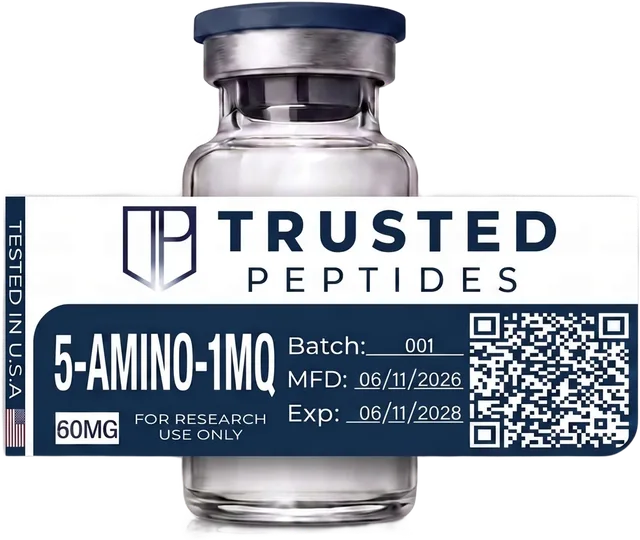


5-amino-1MQ research requires careful separation of compound identity, analytical evidence, and biological interpretation. For a laboratory team, the useful starting point is not a claim about an outcome; it is a documented material, a defined research question, and records that allow another investigator to understand what was tested.
Contact the research-supply team about documentation
This guide outlines a research-only framework for assessing 5-amino-1MQ materials and evidence. It covers naming and identity checks, what chromatographic and mass-spectrometric records can and cannot establish, how to organize batch-level documentation, and how to avoid drawing conclusions beyond the study design. It does not provide use instructions, dosage guidance, or medical advice. Products discussed in this context are for research, laboratory, or analytical purposes only, are not for human consumption, and are not intended to diagnose, treat, cure, or prevent disease.
What should a 5-amino-1MQ research record establish first?
Start with the exact material designation
Record the compound name exactly as it appears on the supplier label and accompanying documentation, including punctuation and any catalog identifier. “5-amino-1MQ” is a name, not a complete analytical specification. A label alone does not establish molecular identity, purity, lot history, or suitability for a particular experimental question.
Researchers should distinguish the named test material from related compounds, reference materials, solvents, and analytical standards used in the same project. If a protocol, notebook, or instrument file uses a shorthand, define it once and preserve the relationship to the full name and batch identifier. This small recordkeeping step reduces ambiguity during analysis and when results are revisited months later.
Do not infer peptide structure from a peptide supplier
The presence of a compound in a research-peptide catalog does not establish that it is a peptide. 5-amino-1MQ is commonly described as a small-molecule research compound rather than a peptide sequence. Accordingly, do not assume that peptide-specific descriptors such as amino-acid sequence or peptide molecular-weight expectations apply. Check the supplier's compound-specific records and the analytical method appropriate to the material rather than relying on a category name or product-page shorthand.
For practical record design, keep the identity claim and the evidence supporting it together. Include the documented name, batch or lot number, date received, storage and handling conditions as provided, and the identity results reported for that specific material. Where chemical identifiers or a structural representation are included in source records, transcribe them carefully rather than independently “correcting” a discrepancy. Resolve differences with the supplier or the responsible analytical group before using the material in a study.
Define the research question separately from the product description
A material description is not a study rationale. Write the experimental question in terms of the model, conditions, comparator, measurement, and planned analysis. Avoid converting background literature, product copy, or a proposed hypothesis into a statement of established action. Compound-level observations should be described as observations from specified laboratory or preclinical investigations, with the model and limits stated.
This distinction is particularly important when the study topic has consumer-facing claims circulating online. A laboratory result in a specific experimental system does not establish a clinical effect, a safe use, or an outcome in people. Keep this article's scope and your own documentation limited to research context.
Which analytical checks help evaluate identity and quality?
Read the COA as a batch-specific record
A certificate of analysis (COA) is most useful when it can be connected to the exact material received. Check that the document identifies the compound and lot or batch, gives a testing date or report reference, and names the analytical method and reported result. Confirm that the document is legible, internally consistent, and available for the material under review, not merely a generic example from another lot.
A purity figure is not a complete identity determination. It describes an analytical result under a particular method and reporting convention. Ask what the reported percentage represents, what signals or peaks are included in the calculation, and whether the report explains limitations or exclusions. Avoid comparing percentages from different methods as if they were automatically equivalent.
Understand what HPLC can contribute
High-performance liquid chromatography (HPLC) separates components in a sample under defined chromatographic conditions. A chromatogram may provide evidence about a major component and detectable secondary peaks within the method's limits. The result depends on method conditions, detector settings, sample preparation, integration choices, and reporting criteria. It should be interpreted with those conditions in view.
HPLC purity reporting should not be mistaken for proof of every aspect of identity or for a universal measure of material quality. A single chromatographic profile cannot necessarily identify every peak, reveal every possible impurity, or establish performance in a separate experimental system. When interpreting a COA, look for the method context, peak information, and a clear connection to the tested batch.
Use complementary analytical evidence when appropriate
Mass spectrometry can provide mass-related evidence relevant to a proposed chemical identity. Its interpretation depends on the instrument, ionization and acquisition conditions, and the expected species. A reported mass signal should be read alongside the method and other identity evidence rather than treated as a stand-alone guarantee of purity or complete structural characterization.
Other techniques may be relevant depending on the material and research question. The important principle is method fit: the analytical approach should be capable of addressing the specific identity or quality question being asked. Do not assume a test was performed simply because a supplier mentions testing in general. Review the available report and its stated methods.
Compare evidence types without treating them as interchangeable
- Batch-specific COA: Helps document reported results associated with a named lot and test date. It does not establish that every possible attribute or application has been validated.
- HPLC chromatogram: Helps document a separation profile and reported chromatographic purity under stated conditions. It does not establish complete identity of all peaks or equivalence to results from another method.
- Mass spectrometry result: Provides mass-related evidence relevant to a proposed identity. It does not establish full purity, complete structure, or experimental performance on its own.
- Label and shipment record: Helps document product designation, lot traceability, and receipt history. It does not establish analytical identity or independent verification.
- Study notebook and raw data: Helps document experimental conditions, observations, and analysis history. It does not establish generalizability beyond the tested model and conditions.
The table is a review aid, not a substitute for qualified analytical interpretation. The exact evidence needed depends on the study purpose and institutional procedures. A repeatable review sequence can make purchasing checks more consistent.
- Compare the product name and lot identifier on the vial with the order record and COA.
- Confirm that the report names a method and clarifies what result is reported.
- Note whether the document explains the basis for its purity calculation and identifies relevant limitations.
- Record who reviewed the files, when the review occurred, and which questions remain open.
This process does not certify the material; it creates a clearer decision trail.
For example, a reviewer might find that the vial and COA share a batch number, but the report provides only a single purity value and no chromatogram. The record should state both what matches and what remains unavailable; it should not translate the percentage into an unsupported claim of complete identity. A second reviewer can then decide whether the available documentation fits the planned analytical or experimental question, or whether clarification is needed first. This explicit distinction prevents a missing record from being silently treated as a favorable result.
Keep vendor-provided information distinct from work performed independently by the receiving laboratory. If the laboratory conducts its own analysis, preserve those results separately and document the sample preparation and method. Do not combine supplier data and in-house results in a summary without labeling the source of each observation. Clear provenance helps a downstream reader avoid mistaking a supplier report for an independent replication.
For a study that compares multiple lots or materials, use the same template for identifiers, report versions, analytical methods, and unresolved questions. If records differ, describe the difference rather than quietly normalizing it. A consistent process makes it easier to determine whether a later observation is associated with a particular batch or with a change in analytical documentation.
A team can review available batch documentation in the COA library and consult the supplier's purity and testing information for the stated quality documentation approach.
Check traceability from report to sample
Document how the vial identifier, label, order record, and analytical report relate to one another. Record the date of receipt and any transfer between storage locations or responsible personnel according to laboratory procedures. If a report does not show a lot identifier, or the identifier differs from the label, pause and clarify the record before attributing results to that sample.
Preserve original report files in a controlled project location, with a descriptive filename and a link or cross-reference in the electronic or paper notebook. If a later corrected report is issued, retain the original and note which document supersedes it and why. This allows a reviewer to reconstruct the evidence available when a study decision was made.
A concise traceability entry can identify the sample as received, list the linked report filenames, note the date of review, and record any action taken on an inconsistency. For instance, if the label uses a shortened product name while the report uses a fuller designation, record the exact wording from both and document how the team verified they refer to the same batch. Avoid overwriting the original label transcription with a normalized version. Keeping both the source wording and the resolved interpretation helps preserve an auditable history.
Ask focused questions when documentation is incomplete
When a COA is missing context, ask precise questions: Which lot was tested? What method and detector were used? What does the reported purity calculation include? Is the report for the material shipped? Are any method limitations noted? A focused question is more likely to produce a useful record than a general request for a “purity guarantee.”
Trusted Peptides describes its batches as independently HPLC-tested with public COAs. Review the batch-specific record rather than relying on the general statement alone. For additional supplier background, consult the company information page, and use the contact page for research supply questions.
How should researchers interpret evidence without overreaching?
Separate analytical evidence from experimental evidence
Analytical quality records address the material and the method used to test it. Experimental data address observations made under a study's defined conditions. A COA does not demonstrate a biological effect. Conversely, an observed result does not retroactively prove that the starting material was correctly identified or characterized. Keep both evidence streams in the research record and make the relationship between them explicit.
For every result, identify the material batch, model or assay, controls, measurement method, and analysis choices. Record deviations and exclusions. When a finding is preliminary, label it as such. If the available evidence supports only a narrow observation in a particular model, do not generalize it to other models, settings, or people.
Build controls around the question, not the expected result
Study controls should be selected by the responsible research team in accordance with the model, institution, and applicable protocols. At the planning stage, specify what each control is intended to address, how outcomes will be measured, and how data will be handled. This makes it easier to distinguish a signal from procedural variation or an analytical artifact.
Maintain a record of instrument settings, assay version, sample identifiers, and relevant environmental or procedural conditions. Where a result depends on a threshold or data-processing choice, document the rule before interpreting the result. Do not present an exploratory observation as a confirmed conclusion simply because it aligns with a hypothesis.
One useful planning exercise is to map each proposed conclusion to the evidence that would be needed to support it. If the question concerns material identity, the record should point to the relevant analytical evidence. If it concerns a measured response in a model, the plan should identify the model, comparator, endpoint, and analysis procedure. If the conclusion would extend beyond that model, identify what additional evidence would be necessary rather than allowing the broader claim to appear by implication. This makes the scope of the eventual report easier to review.
Use primary sources carefully
When reviewing literature, record the source, study type, model, methods, and limitations alongside each relevant claim. A title or abstract is not a substitute for examining the methods and results. Distinguish peer-reviewed research, preprints, supplier material, and commentary. If a source does not clearly describe the compound, analytical verification, or experimental conditions relevant to your question, it may not support that point.
Regulatory status and product evaluation are separate from analytical characterization. The U.S. Food and Drug Administration provides agency information at its official website; a general agency homepage is not a compound-specific evaluation or approval record. Products in this context have not been evaluated by the FDA and are offered only for laboratory and research use. This does not replace review of applicable institutional and regulatory requirements.
Maintain a clear boundary between research and consumer claims
Do not translate results from in vitro systems, animal models, or other preclinical settings into statements about human effects, dosing, safety, treatment, or outcomes. Avoid consumer-oriented directions and claims in study notes or public summaries. Use precise formulations such as “observed under the stated experimental conditions” and identify the model rather than implying that the result applies beyond it.
For material selection and supply context, start with the research compound catalog and review the product's available documentation. The supplier's research-use FAQ provides additional context about ordering and research-only positioning. Availability or a product description is not evidence for a scientific conclusion.
Ask about research-supply documentation
Frequently Asked Questions
Is 5-amino-1MQ a peptide?
It is commonly described as a small-molecule research compound rather than a peptide sequence. Do not infer chemical class from the type of store or catalog listing. Confirm the compound-specific identity details in appropriate analytical and supplier documentation.
Does an HPLC purity result prove compound identity?
Not by itself. An HPLC result describes a separation and reported profile under stated conditions. It may support a purity assessment, but identity claims should be evaluated using the method details and suitable complementary evidence. A COA should also be traceable to the batch being reviewed.
Does a COA establish that a compound will produce a particular result?
No. A COA documents analytical findings about a material. It does not establish an experimental outcome, validate a particular model, or demonstrate a clinical effect. Experimental conclusions must come from appropriately designed and documented research.
What should a research team do if the label and COA do not match?
Do not assume that the documents refer to the same material. Preserve both records, record the discrepancy, and request clarification tied to the specific lot before making a study decision. Follow applicable institutional purchasing and quality procedures.
Research Documentation for Your Next Study
A defensible 5-amino-1MQ research record connects the named compound and lot to its analytical evidence, then connects that material to a defined study question and documented observations. Review the limits of each method, preserve traceability, and keep conclusions within the model and data actually examined.
For additional batch records, browse the COA library or contact Trusted Peptides with a research-supply documentation question. Products are for research, laboratory, or analytical purposes only, not for human consumption, and are not intended to diagnose, treat, cure, or prevent disease.