

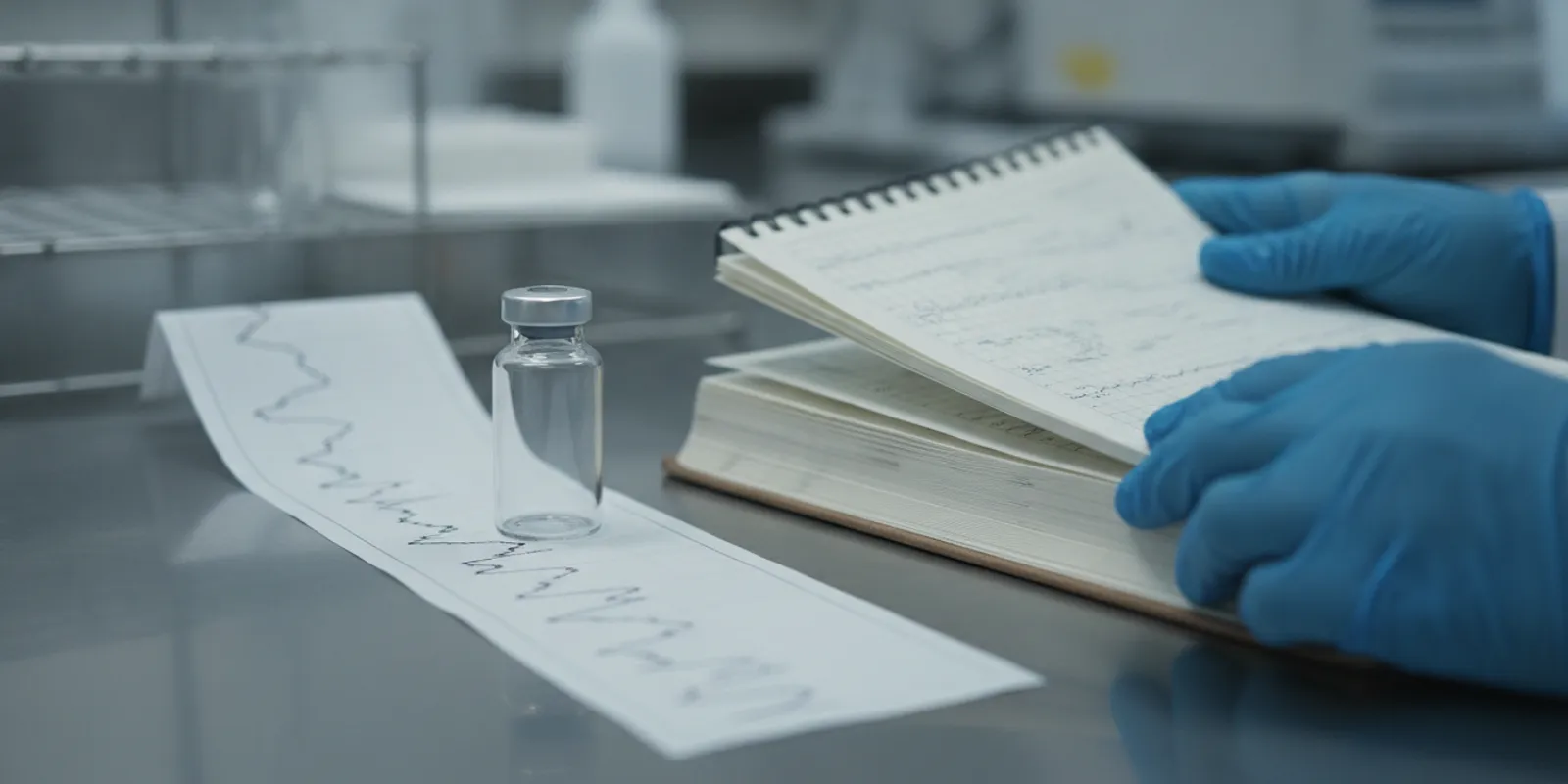
A G2 research peptide record should begin with a precise identity question: what material, batch, and analytical evidence are being evaluated? A short label alone does not establish sequence, molecular mass, purity, or suitability for a particular experimental design. This guide outlines a documentation-first workflow for research teams to assess identity information, interpret analytical checks within their limits, and preserve study context without treating a supplier description as a substitute for laboratory evidence.
Contact the research-supply team with documentation questions
What should a G2 research peptide record establish first?
Before comparing analytical results, define the test article. “G2” is a short label, not a complete chemical specification. It may be insufficient on its own to distinguish a sequence, molecular form, salt or counterion, modification, or formulation. Do not infer any of those characteristics from a shorthand name. Confirm them in the material specification and the batch-specific records that accompany the sample.
Public descriptions can also use a shorthand term without supplying the underlying evidence. For example, online pages that use the phrase “G2 peptide” should be treated as secondary context, not as a source of batch identity or experimental acceptance criteria. A general discussion of G2 and synthetic research agents does not replace an authenticated specification, certificate of analysis, or laboratory record for the material being assessed. Use primary documentation for decisions about a particular sample.
Record the exact material designation
Capture the name exactly as it appears on the vial label, order record, and certificate of analysis (COA). Preserve capitalization, hyphens, suffixes, and any stated form. If a label says only “G2,” record that exact wording and note that the designation is incomplete until reconciled with a more detailed specification. Do not silently expand a shorthand name or substitute a similar-looking compound name.
Where documentation provides a sequence, molecular weight, modification, or formulation, transcribe each field separately. Mark a field “not stated” when the source does not provide it. This is more useful than filling gaps from a search result or from a different batch. If an identity detail remains unresolved, ask the supplier for clarification and retain the response alongside the original record.
Connect the sample to a batch
A traceable record connects the material in the experiment to the batch documentation. Capture the lot or batch identifier, container label, date received, date opened, storage conditions stated on the supplied documentation, and the location of the associated COA. If the identifier on the container differs from the paperwork, pause the evaluation and document the discrepancy rather than choosing one value.
Use one consistent identifier across the inventory system, bench record, raw-data files, and final report. If a sample is divided into aliquots, give each aliquot a linked identifier and retain the parent batch number. The chain should remain understandable to a colleague who did not receive or handle the material.
Separate supplied specifications from observed results
Keep vendor-provided values and laboratory-generated measurements in distinct fields. A specification describes what the material is represented to be; a result records what a particular analytical procedure observed. The two can inform one another, but they are not interchangeable. Note the document version, issuing party, test date if provided, and method details available to your team.
A COA is useful when it is linked to the relevant batch and identifies the material and analytical result clearly. A generic quality statement without a batch link cannot answer the same question. Trusted Peptides states that its batches are independently HPLC-tested and provides public COAs; researchers can consult the COA library and verify whether the documentation available for a specific item fits their records and needs.
Define the intended analytical question
Write down the question before selecting a test. Is the aim to check an expected mass, assess a chromatographic profile, investigate a formulation, or compare a lot with a defined acceptance criterion? Each question calls for different evidence. A test selected only because it is familiar may generate data that look precise but do not resolve the uncertainty that matters.
Specify the decision the result will support, the method and its limitations, and who will review any discrepancy. This helps prevent a single measurement from being treated as a complete statement about identity, purity, stability, or performance.
Which analytical checks help evaluate identity and quality?
Analytical methods answer different questions. HPLC, mass spectrometry, NMR, and spectroscopic techniques can contribute useful evidence, but no method should be interpreted outside its scope. The appropriate combination depends on the stated material, the research question, and the laboratory’s validated procedures. The comparison below is a planning aid, not a substitute for method development or acceptance criteria.
Check or record
What it can help assess
What it does not establish alone
Useful record detail
HPLC chromatographic profile
Retention behavior and a chromatographic purity-related profile under the stated conditions
Complete sequence identity, every possible impurity, or performance in an experiment
Method conditions, detector, integration approach, sample and batch identifiers
Mass spectrometry
Measured mass-related evidence that can support an identity assessment
Full sequence confirmation, formulation homogeneity, or purity by itself
Instrument or method, expected and observed values, calibration and interpretation notes
NMR or other structural method
Structural information appropriate to the method and sample
All batch attributes or experimental behavior
Acquisition conditions, assignment basis, spectra location and reviewer
UV-Vis or other spectroscopic check
Absorbance or spectral features within the method’s validated range
Unambiguous identification without supporting evidence
Wavelength range, blank, preparation record and instrument details
COA and chain-of-custody review
Traceability between stated batch information and supplied test documentation
Independent confirmation that a record matches a sample unless identifiers are reconciled
COA version, lot number, issuer, date and discrepancy resolution
Read an HPLC result as a method-dependent profile
High-performance liquid chromatography separates components under specified conditions and produces a chromatographic profile. The apparent area percentage can be informative within the method, but it depends on the column, mobile phase, gradient, detector response, integration, and other conditions. A reported percentage should not be treated as a universal measurement independent of its method.
When reviewing a chromatogram or COA, check whether the batch identifier matches, whether the analyte is named clearly, and whether the method or its conditions are described. Look for notes about the main peak, integration, and report scope. If the COA does not provide enough detail to interpret a field, mark the limitation rather than assuming a result is more comprehensive than stated. For general documentation context, Trusted Peptides describes its quality and purity documentation; researchers should still assess the record for the specific material and batch.
Use mass-related evidence carefully
Mass spectrometry can provide a measured mass-related signal that supports an identity assessment. Interpretation depends on the expected molecular form, instrument and acquisition conditions, charge states, adducts, and data processing. A close match to an expected value may support one part of the identity case, but it does not by itself establish the complete sequence or exclude all impurities.
Record both the expected basis and the observed result, rather than saving only a conclusion such as “matches.” Preserve the raw or processed data according to laboratory policy and identify the reviewer. Where a proposed material has modifications or a stated salt form, ensure that the comparison accounts for the specified form rather than relying on an unspecified nominal value.
Use orthogonal evidence when the question warrants it
Orthogonal methods rely on different measurement principles. Combining an appropriate chromatographic profile with a mass-related check may provide a broader assessment than either result alone. Structural methods can add another kind of evidence where justified. More tests are not automatically better: methods should be selected to address an explicit uncertainty, and their results interpreted together with limitations.
For each method, record the sample preparation, instrument or method identifier, analyst, date, controls, and acceptance criteria established before interpreting the result. If an in-house check conflicts with the supplied COA, preserve both results, investigate possible causes, and document the disposition. Do not discard discordant data simply because one result is inconvenient.
Review the COA for scope and traceability
A focused COA review starts with the match between the document and the physical material. Confirm the product designation, batch number, and any stated test date or method. Then assess what the report actually presents: a result, a range, a pass statement, or a method-specific profile. If a field is absent, it is unknown from that document.
Save the document in a controlled location and record its source and retrieval date. For a current research supply question, use the supplier’s contact page to request clarification about available records. Do not treat a promotional description, a generic page, or an unrelated batch’s COA as a substitute for the relevant evidence.
Distinguish purity, identity, and suitability
Purity-related reporting, identity evidence, and suitability for a specific experiment are separate conclusions. A sample may have a documented chromatographic profile while an identity question remains open. A plausible identity result does not show that a material is suitable for every assay or experimental condition. Suitability requires criteria tied to the protocol and the research question.
Keep these conclusions separate in reports. State which evidence supports identity, what the purity-related method measures, what remains unknown, and how the team decided whether to proceed within its approved research procedures. Avoid turning a supplier’s specification into a broad guarantee about data outcomes.

How should teams preserve study context and evidence limits?
Good records make it possible to interpret a result later, including when the outcome is unexpected. That requires more than attaching a COA. Capture the experimental context, link each observation to the sample and batch, and make clear which decisions were planned before results were reviewed. A disciplined record also helps a second researcher repeat the procedure without guessing what an abbreviation or undocumented adjustment meant.
Build a sample-level record
For every sample, record the material designation, supplier, batch identifier, receipt date, container identifier, and the source and version of its documentation. Include the study identifier, protocol version, experiment date, operator, and relevant instrument IDs. Note any handling or preparation performed under the laboratory’s approved procedures, but do not rely on memory to reconstruct steps afterward.
For raw data, use filenames that connect to the sample and run without embedding sensitive or unnecessary personal information. Retain original files, processed outputs, and a clear record of transformations. Keep the analysis script or settings where applicable, and note any manual review, exclusion, or repeat analysis.
Predefine comparisons and acceptance criteria
Before a run, identify the comparison groups, controls, primary readouts, and criteria used to judge whether the run is interpretable. Document reasons for those choices. If the protocol changes, record what changed, when, who authorized it, and whether the change occurred before or after data review.
Use a control strategy appropriate to the assay and local procedures. Distinguish a technical control from a comparator material and from a blank; they address different potential sources of variation. Record control outcomes with the same care as sample outcomes. A table or run sheet that lists planned conditions and actual conditions side by side can make deviations easier to identify.
Log deviations and unexpected findings
Record deviations as they happen, including the event, time, affected samples, immediate action, and later assessment. Do not rewrite the original entry to make the run appear closer to plan. A transparent correction or addendum preserves what occurred and why the team made a decision.
Unexpected peaks, inconsistent replicates, label discrepancies, instrument interruptions, or missing records should be treated as information to investigate. Keep observations factual and separate them from hypotheses. Where an issue affects interpretation, state that limitation in the results and explain what follow-up would be needed before a stronger conclusion is warranted.
Keep supplier documentation and study records connected
Store the batch COA, receipt record, study log, and analytical outputs so that their relationship is clear. A simple index can map batch identifier to document filename, experiment identifier, and sample codes. Limit overwriting and preserve version history according to institutional policy. If records are shared with collaborators, include enough context for them to identify which version and sample are under discussion.
Researchers can browse the research compound catalog for product information and check the research-use FAQ for general purchasing and documentation questions. Product pages and general FAQs do not replace the batch-specific record or a laboratory’s own review.
State limits in the final report
Report what the evidence supports and what it does not. Identify the material using the available specification, state which analytical checks were reviewed or performed, and describe any gaps. Avoid converting a limited analytical result into an unqualified statement about all properties of a compound or its behavior in an experimental system.
A concise limitations paragraph can name the unresolved identity fields, method constraints, unavailable raw data, or sample-handling uncertainties. This is not a weakness in the report. It helps readers understand the strength of the evidence and prevents conclusions from extending beyond the recorded work.
Apply research-only boundaries to communication
Keep product and educational language within laboratory, analytical, or research contexts. Do not provide consumer-use directions or frame experimental observations as established outcomes beyond the study setting. Trusted Peptides is a chemical supplier, not a pharmacy or compounding facility, and its products are not evaluated by the FDA.
For laboratory procurement, teams may review the supplier’s company information and shipping information, then assess available documentation through their own institutional processes. Research decisions remain the responsibility of qualified personnel following applicable laws, institutional policies, and approved protocols.
FDA Disclaimer:The statements made within this website have not been evaluated by the US Food and Drug Administration. The statements and the products of this company are not intended to diagnose, treat, cure or prevent any disease. All products are sold for research, laboratory, or analytical purposes only, and are not for human consumption. TPRX LLC is a chemical supplier. TPRX LLC is not a compounding pharmacy or chemical compounding facility as defined under 503A of the Federal Food, Drug, and Cosmetic act. TPRX LLC is not an outsourcing facility as defined under 503B of the Federal Food, Drug, and Cosmetic act.
Ask about research documentation and supply records
Frequently Asked Questions
Does the name G2 alone identify a peptide?
No. A short designation alone may not specify sequence, molecular form, modification, or formulation. Use the exact label and reconcile it with a detailed specification and batch-linked records. Treat missing identity fields as unresolved rather than filling them from assumptions.
Does an HPLC result confirm complete identity?
No. HPLC provides a chromatographic profile under stated conditions and can support a purity-related assessment. It does not alone establish complete sequence identity or suitability for a particular experimental application. Interpret it with its method details and other relevant evidence.
What should a research team check first on a COA?
Confirm that the document identifies the same material and batch as the sample. Then review the method and scope of each result, the reporting date if present, and any stated limitations. Save the document with its source and connect it to the study’s sample records.
What should teams do when the label and COA do not match?
Pause the evaluation, retain the original records, and document the exact discrepancy. Request clarification through the appropriate supplier contact and do not choose one identifier without a traceable resolution. Record the resolution and link it to the affected sample and study.
Can a supplier COA replace in-house study documentation?
No. A COA is one component of the material record. The laboratory still needs its own traceability, protocol, sample handling, controls, raw data, deviations, and interpretation records to explain its experimental work.
Research Documentation for Your Next Study
Reliable interpretation starts with a clear material identity, a batch-linked COA, fit-for-purpose analytical checks, and records that preserve the experimental context. If documentation for a research supply needs clarification, contact the research-supply team with the material designation and batch details available to your laboratory.
A careful record shows both what the evidence supports and where uncertainty remains, giving the research team a sound basis for its next review.