

Peptide lot release testing is a documented quality-control review performed before a defined research material enters laboratory work. It connects lot identity, analytical results, and certificate of analysis data.
It also connects packaging records and lab-defined acceptance criteria. Together, these records help procurement and research teams make a traceable decision for the receiving and research teams. The resulting file gives technical reviewers a shared record for questions, holds, and final disposition.
This article presents a high-level framework for research, laboratory, or analytical purposes only. It is not a product-specific release certificate or a regulatory approval pathway.
It is also not a clinical protocol. It does not replace a laboratory's validated methods, quality system, or project-specific review. Each laboratory remains responsible for its own technical decisions.
Products discussed in the context of Trusted Peptides are for research use only. They are not for human consumption and are not intended to diagnose, treat, cure, or prevent disease.
What Is Peptide Lot Release Testing?
Peptide lot release testing reviews a defined production lot against pre-established identity, purity, documentation, and handling requirements. The review occurs before the lot enters a research supply workflow.
The exact tests and limits depend on the material, method capability, research objective, and quality system responsible for the decision. The framework must therefore remain specific to the laboratory and material. A written scope prevents reviewers from treating a general checklist as a product specification.
Lot release is a decision, not just an instrument run
A chromatogram or mass spectrum is evidence, but it is not the complete release decision. A defensible review asks whether the sample was linked to the correct lot and whether the method was suitable.
It also asks whether the result was interpreted correctly. The record should be complete enough for another qualified reviewer to reconstruct the decision and understand the release rationale.
Research release is different from a regulated product release
The FDA describes lot release for certain regulated biologics as a system that can include review and testing of each lot before distribution.
That regulatory process is not the same as a research supplier's internal quality review. The distinction should remain clear in procurement and quality documentation.
It is also distinct from a customer-side review of research materials. A lab should define its own responsibilities rather than assume that one record covers every quality question.
For research materials, use regulatory concepts as background. Define the actual scope, responsibilities, and acceptance rules for the laboratory's own work. Keep those limits visible to procurement, receiving, and technical reviewers. This clarity reduces avoidable handoff errors during receiving and technical review.
The FDA lot release overview is useful for understanding why lot-specific protocols, results, and review records matter. It should not be read as a claim that a research-only peptide has FDA evaluation or approval.
Which Objectives Should a Lot Release Review Address?
A lot release review should answer a narrow operational question: does this identified research material have enough verified information and acceptable analytical evidence for the next step in the laboratory workflow?
The review should state what was checked, which records support it, who made the decision, and what remains unresolved. This makes the decision easier to audit and revisit. It also gives the next reviewer a clear starting point when a question returns.
Confirm the material identity
Start with the peptide name, sequence or product identifier when available, presentation, lot number, container identifier, nominal amount, and supplier record. Match the physical container and shipping documents to the lot-specific documentation.
A correct analytical result attached to the wrong lot is not useful evidence for release. Lot identity must remain connected to every document used in the decision.
Define the intended research use of the record
Release records should identify the research program, study file, or laboratory inventory record that will receive the material. This does not require publishing proprietary project details.
It does require enough traceability to show where the lot went. Record which version of the documentation was reviewed and whether later results should connect to the same source material.
Separate release evidence from future study results
Lot release confirms the quality attributes and records included in the release decision. It does not guarantee the outcome of an assay or establish behavior in every experimental model.
It also does not replace method validation. Keep supplier release evidence, incoming inspection, and project-specific performance data as separate but linkable records. That separation helps reviewers interpret each record within its proper scope.
How Should Laboratories Review Identity and Purity Evidence?
Identity and purity evidence should be reviewed together but interpreted as different quality attributes. Identity asks whether the material is consistent with the named peptide.
Purity asks how much of the measured sample is represented by the reported principal component or method-defined result. Neither conclusion should be expanded beyond the method and sample tested.
Identity evidence should be lot specific
Depending on the material and available methods, identity evidence may include mass spectrometry, sequence information, chromatographic retention behavior, spectral data, or another orthogonal technique.
The reviewer should confirm that the evidence names the tested lot or sample. The reported method should also be appropriate for the material.
Purity is method dependent
HPLC area percentage, mass-based purity, assay, and total peptide content are not interchangeable measurements. A high area percentage from one chromatographic method does not automatically answer every question about a sample.
It may not address water, residual solvents, counterions, aggregates, or every possible impurity.
The release record should name the method and calculation basis. Do not present purity as a context-free number.
Review related substances and unresolved peaks
When a chromatogram shows secondary peaks, the reviewer should ask whether they are identified, expected, method artifacts, degradation products, process-related impurities, or unresolved signals.
If a peak is not characterized, record it as an uncertainty or investigation item. Do not assign a confident identity without evidence.
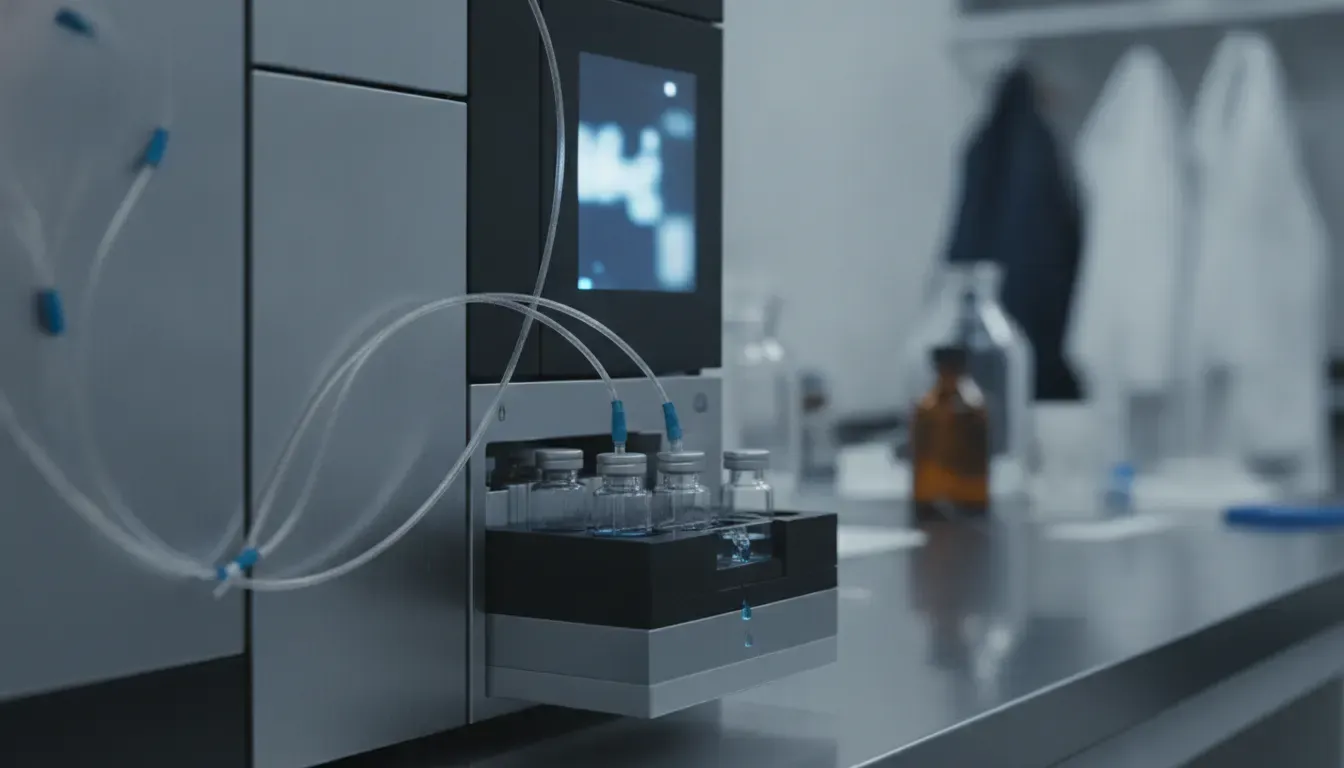
HPLC results are one part of a lot release record and should be interpreted with sample identity and method details.
What Does HPLC Contribute to Peptide Lot Release Testing?
HPLC can support lot release by separating sample components and producing a chromatographic record for review. Its value depends on method suitability, system performance, sample preparation, reference expectations, and interpretation.
HPLC is evidence for defined attributes. It is not a universal answer to every question about a research peptide. Interpret the result alongside the method context, lot identity, and other required records.
Review the chromatographic method context
A reviewer should know the separation mode, detector approach, relevant mobile-phase conditions, run context, sample preparation, and calculation basis.
The record should identify the instrument or analytical laboratory, method version, test date, and sample identifier. These details make a result reproducible and help explain differences between lots or laboratories.
Check system suitability and run integrity
Before evaluating sample peaks, review whether the system met the method's suitability checks. Consider injection repeatability, retention behavior, resolution where applicable, baseline quality, blanks, reference material, and documented deviations.
A result from a run with a failed or undocumented suitability check should be held for review. Do not treat it as routine pass evidence.
Read the COA with the chromatogram when possible
A certificate of analysis may summarize the result, while the chromatogram provides additional context about peak shape, secondary peaks, and integration. If only a summary is available, record that limitation.
When underlying data is available, confirm that the COA lot number, sample label, method, result, and conclusion agree with the primary record.
The Trusted Peptides peptide purity resource provides adjacent educational context. For supplier documentation, the laboratory testing and COA page is the appropriate place to review available research-supply documentation.
How Should Procurement Teams Interpret a Peptide COA?
A peptide COA should be treated as a controlled record that links a named lot to reported tests and results.
Procurement teams should review its identity, issuing laboratory, dates, methods, result units, acceptance language, and lot number.
Route technical questions to a qualified laboratory reviewer. Do not rely on a score or a single percentage.
Verify the lot and product identifiers
Compare the COA with the container label, purchase record, packing information, and internal receiving record. Check spelling, lot or batch number, presentation, and any sample identifier.
If the COA uses a product code, retain the cross-reference that connects it to the material received.
Check the testing laboratory and report controls
Review the issuing laboratory name, report date, document identifier, revision or version, analyst or reviewer fields when supplied, and any signature or approval information.
These details do not independently prove a result. They help establish document control and route questions to the right source.
Distinguish results, limits, and conclusions
A reported result is not the same as an acceptance limit. A result may be stated as an observation, while a specification may define a permitted range.
The conclusion should identify whether the result met the stated criterion for the tested attribute.
If the COA does not state a limit or method, mark that gap for technical review. Do not infer a universal threshold.
Record what the COA does not establish
A COA generally does not establish suitability for every assay, stability under every storage condition, compatibility with every matrix, or performance in an organism.
It is one component of a quality file. A lab may require additional incoming testing, identity confirmation, or project-specific qualification based on its risk assessment.
For comparison, the Trusted Peptides COA library can be reviewed alongside the lot record. Do not use an older certificate for a different lot as a substitute for current lot documentation.
What Documentation Should Accompany a Release Decision?
Documentation makes a release decision auditable. A complete file should allow a second reviewer to determine what material was received and which evidence was examined.
It should also show what criteria were applied, who approved or held the lot, and what actions are required before the material enters the research inventory.
Build a lot record and receiving record
At receipt, record the shipment date, receiving condition, container count, label details, lot identifier, storage transfer, and any visible discrepancy.
Photographing or scanning labels may be appropriate under the laboratory's document-control policy. Note temperature or packaging observations only when they were actually measured or observed.
Attach analytical evidence and method references
Keep the COA, chromatogram or analytical report when available, method identifier, instrument or laboratory information, sample preparation record, and any deviation record together.
If data is hosted in a laboratory information management system, the release file should include a stable reference and access path rather than an untracked screenshot.
Capture the decision and reviewer role
Use explicit dispositions such as accepted, held for clarification, rejected under the lab's process, or conditionally accepted with a documented restriction.
Identify the reviewer, date, criteria version, and follow-up owner. Avoid vague notes such as "looks good" because they cannot be evaluated later.
Maintain chain of custody after release
Release is not the end of traceability. Record inventory location, container opening, transfers, aliquoting, preparation, disposal, and any subsequent testing that changes the material's status.
The chain should distinguish the original supplier lot from laboratory-derived samples. This distinction matters when later observations must be traced to the original material or a derived preparation.

Procurement and laboratory reviewers can use a shared lot record to connect physical samples with quality documentation.
Which Acceptance Criteria Are Appropriate at a High Level?
Acceptance criteria should be written before review and tied to the material, method, and research decision.
There is no universal release threshold for every peptide, presentation, laboratory, or analytical method. The laboratory should document why each criterion fits its material and research decision.
Criteria should state what is required and what evidence supports it. They should also state what happens when a result is incomplete or outside the defined range.
Use attribute-specific criteria
Separate identity, purity, related substances, appearance, container condition, documentation completeness, and project-specific attributes.
This prevents one strong result from masking a missing result in another critical area. Each criterion should identify the method or record used for evaluation.
Define hold and investigation triggers
Common triggers include a lot mismatch, missing COA, damaged container, unexplained chromatographic peak, failed system suitability, missing method information, result outside the stated limit, or an unresolved deviation.
A hold is a controlled status, not a silent rejection. Assign an owner and document the next review step.
Use a decision matrix without inventing specifications
The following matrix is a planning template. It does not set a numerical specification for any Trusted Peptides product or any other research material.
- Identity: Evidence: lot label, product identifier, sequence or orthogonal analytical evidence. Decision question: does the evidence correspond to the material and lot received? Follow-up: hold and request clarification or additional identity evidence.
- Purity: Evidence: HPLC or other method result, calculation basis, and report context. Decision question: does the result meet the lab-defined criterion for this method? Follow-up: technical review, repeat testing, or documented disposition.
- Related substances: Evidence: chromatogram, peak review, and impurity information. Decision question: are secondary signals characterized or appropriately investigated? Follow-up: open an investigation and avoid unsupported peak assignments.
- Documentation: Evidence: COA, method, report date, version, and reviewer fields. Decision question: can another reviewer reconstruct the decision? Follow-up: request the missing record or place the lot on hold.
- Container and receipt: Evidence: label, packaging, receiving inspection, and storage transfer. Decision question: was the lot received and stored with no documented discrepancy? Follow-up: record the deviation and assess impact before disposition.
The ICH Q6B guideline discusses the relationship between test procedures, specifications, and acceptance criteria for biotechnological and biological products. It is a methodological reference, not a ready-made specification for a research-only peptide. The USP peptide standards resource also illustrates why reference materials and validated analytical approaches matter when laboratories develop or qualify methods.
How Can Teams Improve the Lot Release Workflow?
A reliable workflow reduces avoidable ambiguity by assigning ownership before the material arrives.
- Procurement confirms the commercial and lot records.
- Receiving staff document the physical shipment.
- Technical reviewers assess analytical evidence.
- The laboratory quality owner controls final disposition and follow-up.
Use a standard pre-review checklist
Ask whether the correct lot arrived, the container is identified, storage transfer is documented, and the COA is available.
Also check that the analytical method is named, results are legible, criteria are current, deviations are recorded, and the decision owner is assigned. A checklist improves consistency without replacing scientific judgment.
Version the criteria and forms
Keep the criteria version, checklist version, method version, and report revision visible in the release record.
If the laboratory changes its acceptance approach, preserve the prior decision basis. This prevents a later reviewer from judging an older lot against a criterion that did not exist at the time of release.
Link supplier quality records to internal records
Trusted Peptides emphasizes third-party HPLC testing, transparent COA documentation, and batch consistency for research customers.
A lab can preserve those supplier records in its own controlled file. It can then add internal receipt, handling, and project-specific testing records.
The two record sets should support each other without being treated as interchangeable.
Review trends across lots
When a laboratory receives recurring lots, compare results and documentation quality over time. Trend review can reveal recurring deviations, changes in analytical profiles, repeated shipping observations, or gaps in the supplier record.
A trend is a signal for investigation, not proof of a cause. Keep conclusions limited to the data and methods available.
Frequently Asked Questions About Peptide Lot Release Testing
What is the purpose of peptide lot release testing?
Its purpose is to document whether a defined research lot meets the laboratory's pre-established identity, purity, documentation, and receiving requirements before it enters the next stage of work.
It supports traceability and review. It does not guarantee experimental outcomes or establish human-use claims.
Is HPLC enough to release a research peptide lot?
Not necessarily. HPLC can provide valuable separation and purity evidence, but release requirements depend on the material, method, and research risk.
A laboratory may also need identity evidence, COA review, container inspection, related-substance assessment, or additional testing. The release decision should match the written criteria.
How should a lab handle a missing or mismatched COA?
Place the lot on hold under the laboratory's procedure. Document the mismatch and request clarification or corrected documentation.
Do not silently substitute a certificate from another lot. The reviewer should record the final disposition and any impact assessment once the discrepancy is resolved.
Does a high purity value prove peptide quality?
No. A purity value is meaningful only with its method, calculation basis, sample identity, and acceptance context.
It may not address identity, residual materials, container effects, stability, or suitability for a particular assay. Review the whole quality record instead of relying on one number.
Does a lot release decision establish clinical or therapeutic performance?
No. A research lot release decision is limited to the attributes and evidence defined by the laboratory or supplier process.
It does not establish clinical performance, therapeutic benefit, diagnosis, disease prevention, or suitability for human or animal use.
Build a More Defensible Research Supply Record
Peptide lot release testing is strongest when it connects the physical lot, analytical evidence, COA, acceptance criteria, and reviewer decision in one traceable record.
A high-quality process does not depend on a single purity value. It shows what was tested, what was not tested, what the evidence supports, and what the laboratory will do when a result needs clarification.
For additional context, review the peptide handling and stability guide, browse the research peptide information, or visit the Trusted Peptides company overview. These resources should complement, not replace, the laboratory's own quality procedures.
Contact Trusted Peptides to discuss research-supply documentation, COAs, and lot records.